


Page 347 - (DK) Ocean - The Definitive Visual Guide
P. 347
BONY FISHES 345
ORDER SILURIFORMES
Gafftopsail Sea
Catfish
Bagre marinus
LENGTH
Up to 28 in (70 cm)
WEIGHT
Up to 10 lb (4.5 kg)
DEPTH
To 160 ft (50 m)
DISTRIBUTION Gulf of Mexico, Caribbean Sea, and
subtropical waters of western Atlantic
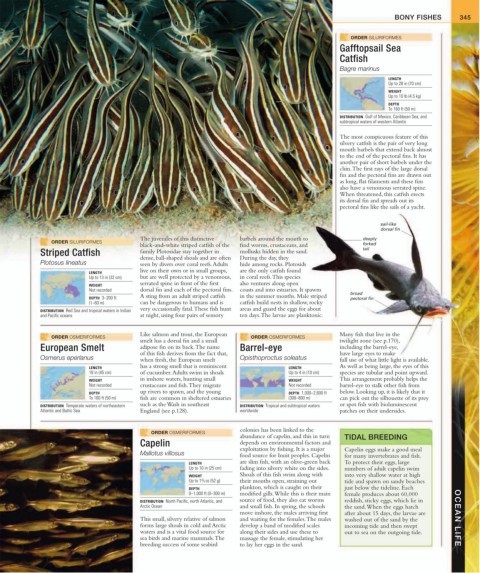
The most conspicuous feature of this
silvery catfish is the pair of very long
mouth barbels that extend back almost
to the end of the pectoral fins. It has
another pair of short barbels under the
chin. The first rays of the large dorsal
fin and the pectoral fins are drawn out
as long, flat filaments and these fins
also have a venomous serrated spine.
When threatened, this catfish erects
its dorsal fin and spreads out its
pectoral fins like the sails of a yacht.
sail-like
dorsal fin
The juveniles of this distinctive barbels around the mouth to deeply
ORDER SILURIFORMES
black-and-white striped catfish of the find worms, crustaceans, and forked
Striped Catfish family Plotosidae stay together in mollusks hidden in the sand. tail
dense, ball-shaped shoals and are often During the day, they
seen by divers over coral reefs. Adults hide among rocks. Plotosids
Plotosus lineatus
live on their own or in small groups, are the only catfish found
LENGTH
Up to 13 in (32 cm) but are well protected by a venomous, in coral reefs. This species
serrated spine in front of the first also ventures along open
WEIGHT
Not recorded dorsal fin and each of the pectoral fins. coasts and into estuaries. It spawns
A sting from an adult striped catfish in the summer months. Male striped broad
DEPTH 3–200 ft pectoral fin
(1–60 m) can be dangerous to humans and is catfish build nests in shallow, rocky
very occasionally fatal. These fish hunt areas and guard the eggs for about
DISTRIBUTION Red Sea and tropical waters in Indian
and Pacific oceans at night, using four pairs of sensory ten days. The larvae are planktonic.
Like salmon and trout, the European Many fish that live in the
ORDER OSMERIFORMES ORDER OSMERIFORMES
smelt has a dorsal fin and a small twilight zone (see p.170),
European Smelt adipose fin on its back. The name Barrel-eye including the barrel-eye,
of this fish derives from the fact that, have large eyes to make
when fresh, the European smelt
Osmerus eperlanus Opisthoproctus soleatus full use of what little light is available.
LENGTH has a strong smell that is reminiscent LENGTH As well as being large, the eyes of this
18 in (45 cm) of cucumber. Adults swim in shoals Up to 4 in (10 cm) species are tubular and point upward.
WEIGHT in inshore waters, hunting small WEIGHT This arrangement probably helps the
Not recorded crustaceans and fish. They migrate Not recorded barrel-eye to stalk other fish from
DEPTH up rivers to spawn, and the young DEPTH 1,000–2,600 ft below. Looking up, it is likely that it
To 160 ft (50 m) fish are common in sheltered estuaries (300–800 m) can pick out the silhouette of its prey
DISTRIBUTION Temperate waters of northeastern such as the Wash in southeast DISTRIBUTION Tropical and subtropical waters or spot fish with bioluminescent
Atlantic and Baltic Sea England (see p.128). worldwide patches on their undersides.
ORDER OSMERIFORMES colonies has been linked to the
abundance of capelin, and this in turn TIDAL BREEDING
Capelin depends on environmental factors and
exploitation by fishing. It is a major Capelin eggs make a good meal
Mallotus villosus food source for Inuit peoples. Capelin for many invertebrates and fish.
LENGTH are slim fish, with an olive-green back To protect their eggs, large
Up to 10 in (25 cm) fading into silvery white on the sides. numbers of adult capelin swim
WEIGHT Shoals of this fish swim along with into very shallow water at high
Up to 1 4 / 5 oz (52 g) their mouths open, straining out tide and spawn on sandy beaches
DEPTH plankton, which is caught on their just below the tideline. Each
0–1,000 ft (0–300 m) modified gills. While this is their main female produces about 60,000
DISTRIBUTION North Pacific, north Atlantic, and source of food, they also eat worms reddish, sticky eggs, which lie in
Arctic Ocean and small fish. In spring, the schools the sand. When the eggs hatch
move inshore, the males arriving first after about 15 days, the larvae are
This small, silvery relative of salmon and waiting for the females. The males washed out of the sand by the OCEAN LIFE
forms large shoals in cold and Arctic develop a band of modified scales incoming tide and then swept
waters and is a vital food source for along their sides and use these to out to sea on the outgoing tide.
sea birds and marine mammals. The massage the female, stimulating her
breeding success of some seabird to lay her eggs in the sand.

