


Page 350 - (DK) Ocean - The Definitive Visual Guide
P. 350
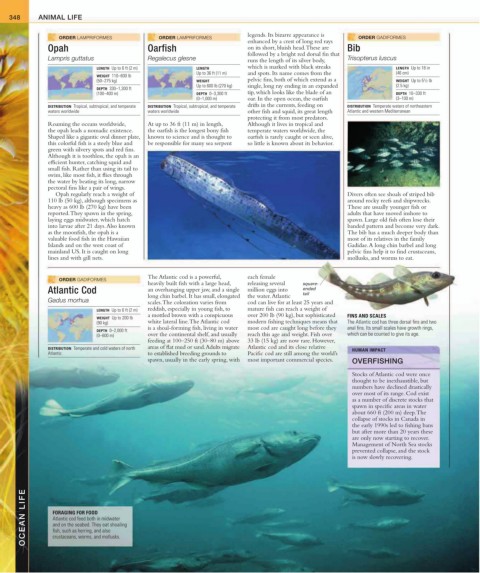
348     ANIMAL LIFE


                  ORDER LAMPRIFORMES            ORDER LAMPRIFORMES         legends. Its bizarre appearance is   ORDER GADIFORMES
                                                                           enhanced by a crest of long red rays
               Opah                          Oarfish                       on its short, bluish head. These are   Bib
                                                                           followed by a bright red dorsal fin that
               Lampris guttatus              Regalecus glesne              runs the length of its silver body,   Trisopterus luscus
                              LENGTH  Up to 6 ft (2 m)     LENGTH          which is marked with black streaks          LENGTH  Up to 18 in
                                                           Up to 36 ft (11 m)  and spots. Its name comes from the      (46 cm)
                              WEIGHT  110–600 lb
                                                                                                                               1
                              (50–275 kg)                  WEIGHT          pelvic fins, both of which extend as a      WEIGHT  Up to 5 / 2 lb
                                                           Up to 600 lb (270 kg)  single, long ray ending in an expanded   (2.5 kg)
                              DEPTH  330–1,300 ft
                              (100–400 m)                  DEPTH  0–3,300 ft   tip, which looks like the blade of an   DEPTH  10–330 ft
                                                           (0–1,000 m)     oar. In the open ocean, the oarfish         (3–100 m)
               DISTRIBUTION  Tropical, subtropical, and temperate   DISTRIBUTION  Tropical, subtropical, and temperate   drifts in the currents, feeding on    DISTRIBUTION  Temperate waters of northeastern
               waters worldwide              waters worldwide              other fish and squid, its great length   Atlantic and western Mediterranean
                                                                           protecting it from most predators.
               Roaming the oceans worldwide,    At up to 36 ft (11 m) in length,    Although it lives in tropical and
               the opah leads a nomadic existence.   the oarfish is the longest bony fish    temperate waters worldwide, the
               Shaped like a gigantic oval dinner plate,   known to science and is thought to    oarfish is rarely caught or seen alive,
               this colorful fish is a steely blue and   be responsible for many sea serpent   so little is known about its behavior.
               green with silvery spots and red fins.
               Although it is toothless, the opah is an
               efficient hunter, catching squid and
               small fish. Rather than using its tail to
               swim, like most fish, it flies through
               the water by beating its long, narrow
               pectoral fins like a pair of wings.
                 Opah regularly reach a weight of                                                       Divers often see shoals of striped bib
               110 lb (50 kg), although specimens as                                                    around rocky reefs and shipwrecks.
               heavy as 600 lb (270 kg) have been                                                       These are usually younger fish or
               reported. They spawn in the spring,                                                      adults that have moved inshore to
               laying eggs midwater, which hatch                                                        spawn. Large old fish often lose their
               into larvae after 21 days. Also known                                                    banded pattern and become very dark.
               as the moonfish, the opah is a                                                           The bib has a much deeper body than
               valuable food fish in the Hawaiian                                                       most of its relatives in the family
               Islands and on the west coast of                                                         Gadidae. A long chin barbel and long
               mainland US. It is caught on long                                                        pelvic fins help it to find crustaceans,
               lines and with gill nets.                                                                mollusks, and worms to eat.


                  ORDER GADIFORMES           The Atlantic cod is a powerful,    each female
                                             heavily built fish with a large head,    releasing several   square-
               Atlantic Cod                  an overhanging upper jaw, and a single   million eggs into   ended
                                             long chin barbel. It has small, elongated   the water. Atlantic   tail
               Gadus morhua                  scales. The coloration varies from   cod can live for at least 25 years and
                              LENGTH  Up to 6 ft (2 m)  reddish, especially in young fish, to   mature fish can reach a weight of
                                             a mottled brown with a conspicuous   over 200 lb (90 kg), but sophisticated   FINS AND SCALES
                              WEIGHT  Up to 200 lb
                              (90 kg)        white lateral line. The Atlantic cod    modern fishing techniques means that   The Atlantic cod has three dorsal fins and two
                                             is a shoal-forming fish, living in water   most cod are caught long before they   anal fins. Its small scales have growth rings,
                              DEPTH  0–2,000 ft
                              (0–600 m)      over the continental shelf, and usually   reach this age and weight. Fish over    which can be counted to give its age.
                                             feeding at 100–250 ft (30–80 m) above   33 lb (15 kg) are now rare. However,
               DISTRIBUTION  Temperate and cold waters of north   areas of flat mud or sand. Adults migrate   Atlantic cod and its close relative   HUMAN IMPACT
               Atlantic                      to established breeding grounds to   Pacific cod are still among the world’s
                                             spawn, usually in the early spring, with   most important commercial species.  OVERFISHING
                                                                                                          Stocks of Atlantic cod were once
                                                                                                          thought to be inexhaustible, but
                                                                                                          numbers have declined drastically
                                                                                                          over most of its range. Cod exist
                                                                                                          as a number of discrete stocks that
                                                                                                          spawn in specific areas in water
                                                                                                          about 660 ft (200 m) deep. The
                                                                                                          collapse of stocks in Canada in
                                                                                                          the early 1990s led to fishing bans
                                                                                                          but after more than 20 years these
                                                                                                          are only now starting to recover.
                                                                                                          Management of North Sea stocks
                                                                                                          prevented collapse, and the stock
                                                                                                          is now slowly recovering.


        OCEAN LIFE  FORAGING FOR FOOD


                 Atlantic cod feed both in midwater
                 and on the seabed. They eat shoaling
                 fish, such as herring, and also
                 crustaceans, worms, and mollusks.

