


Page 349 - (DK) Ocean - The Definitive Visual Guide
P. 349
BONY FISHES 347
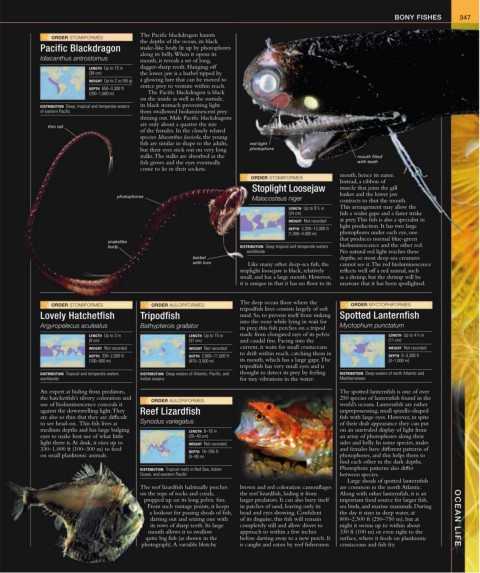
ORDER STOMIIFORMES The Pacific blackdragon haunts
the depths of the ocean, its black
Pacific Blackdragon snake-like body lit up by photophores
along its belly. When it opens its
Idiacanthus antrostomus mouth, it reveals a set of long,
LENGTH Up to 15 in dagger-sharp teeth. Hanging off
(38 cm) the lower jaw is a barbel tipped by
WEIGHT Up to 2 oz (55 g) a glowing lure that can be moved to
entice prey to venture within reach.
DEPTH 650–3,300 ft
(200–1,000 m) The Pacific blackdragon is black
on the inside as well as the outside,
DISTRIBUTION Deep, tropical and temperate waters its black stomach preventing light
of eastern Pacific from swallowed bioluminescent prey
shining out. Male Pacific blackdragons
are only about a quarter the size
thin tail
of the females. In the closely related
species Idiacanthus fascicola, the young
fish are similar in shape to the adults, red-light
but their eyes stick out on very long photophore
stalks. The stalks are absorbed as the mouth filled
fish grows and the eyes eventually with teeth
come to lie in their sockets.
ORDER STOMIIFORMES mouth, hence its name.
Instead, a ribbon of
Stoplight Loosejaw muscle that joins the gill
basket and the lower jaw
photophores
Malacosteus niger contracts to shut the mouth.
1
LENGTH Up to 9 / 2 in This arrangement may allow the
(24 cm) fish a wider gape and a faster strike
WEIGHT Not recorded at prey. This fish is also a specialist in
light production. It has two large
DEPTH 3,300–13,000 ft
(1,000–4,000 m) photophores under each eye, one
that produces normal blue-green
snakelike
body DISTRIBUTION Deep tropical and temperate waters bioluminescence and the other red.
worldwide No natural red light reaches these
barbel depths, so most deep-sea creatures
with lure Like many other deep-sea fish, the cannot see it. The red bioluminescence
stoplight loosejaw is black, relatively reflects well off a red animal, such
small, and has a large mouth. However, as a shrimp, but the shrimp will be
it is unique in that it has no floor to its unaware that it has been spotlighted.
ORDER STOMIIFORMES ORDER AULOPIFORMES The deep ocean floor where the ORDER MYCTOPHIFORMES
tripodfish lives consists largely of soft
Lovely Hatchetfish Tripodfish mud. So, to prevent itself from sinking Spotted Lanternfish
into the ooze while lying in wait for
Argyropelecus aculeatus Bathypterois grallator its prey, this fish perches on a tripod Myctophum punctatum
1
LENGTH Up to 3 in LENGTH Up to 15 in made from elongated rays of its pelvic LENGTH Up to 4 / 4 in
(8 cm) (37 cm) and caudal fins. Facing into the (11 cm)
WEIGHT Not recorded WEIGHT Not recorded current, it waits for small crustaceans WEIGHT Not recorded
to drift within reach, catching them in
DEPTH 330–2,000 ft DEPTH 2,900–11,500 ft DEPTH 0–3,300 ft
(100–600 m) (875–3,500 m) its mouth, which has a large gape. The (0–1,000 m)
tripodfish has very small eyes and is
DISTRIBUTION Tropical and temperate waters DISTRIBUTION Deep waters of Atlantic, Pacific, and thought to detect its prey by feeling DISTRIBUTION Deep waters of north Atlantic and
worldwide Indian oceans for tiny vibrations in the water. Mediterranean
An expert at hiding from predators, The spotted lanternfish is one of over
the hatchetfish’s silvery coloration and ORDER AULOPIFORMES 250 species of lanternfish found in the
use of bioluminescence conceals it world’s oceans. Lanternfish are rather
against the downwelling light. They Reef Lizardfish unprepossessing, small spindle-shaped
are also so thin that they are difficult fish with large eyes. However, in spite
to see head-on. This fish lives at Synodus variegatus of their drab appearance they can put
medium depths and has large bulging LENGTH 8–16 in on an unrivaled display of light from
eyes to make best use of what little (20–40 cm) an array of photophores along their
light there is. At dusk, it rises up to WEIGHT Not recorded sides and belly. In some species, males
330–1,000 ft (100–300 m) to feed and females have different patterns of
DEPTH 16–295 ft
on small planktonic animals. (5–90 m) photophores, and this helps them to
find each other in the dark depths.
DISTRIBUTION Tropical reefs in Red Sea, Indian Photophore patterns also differ
Ocean, and western Pacific between species.
Large shoals of spotted lanternfish
The reef lizardfish habitually perches brown and red coloration camouflages are common in the north Atlantic.
on the tops of rocks and corals, the reef lizardfish, hiding it from Along with other lanternfish, it is an
propped up on its long pelvic fins. larger predators. It can also bury itself important food source for larger fish,
From such vantage points, it keeps in patches of sand, leaving only its sea birds, and marine mammals. During
a lookout for passing shoals of fish, head and eyes showing. Confident the day it stays in deep water, at
darting out and seizing one with of its disguise, this fish will remain 800–2,500 ft (250–750 m), but at OCEAN LIFE
its rows of sharp teeth. Its large completely still and allow divers to night it swims up to within about
mouth allows it to swallow approach to within a few inches 330 ft (100 m) or even right to the
quite big fish (as shown in the before darting away to a new perch. It surface, where it feeds on planktonic
photograph). A variable blotchy is caught and eaten by reef fishermen. crustaceans and fish fry.

