


Page 351 - (DK) Ocean - The Definitive Visual Guide
P. 351
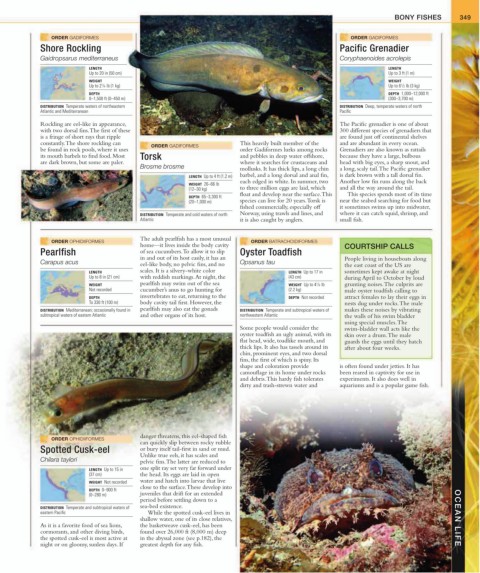
BONY FISHES        349


                ORDER GADIFORMES                                                                         ORDER GADIFORMES
             Shore Rockling                                                                           Pacific Grenadier

             Gaidropsarus mediterraneus                                                               Coryphaenoides acrolepis
                           LENGTH                                                                                    LENGTH
                           Up to 20 in (50 cm)                                                                       Up to 3 ft (1 m)
                           WEIGHT                                                                                    WEIGHT
                           Up to 2 1 / 4 lb (1 kg)                                                                   Up to 6 1 / 2 lb (3 kg)
                           DEPTH                                                                                     DEPTH  1,000–12,000 ft
                           0–1,500 ft (0–450 m)                                                                      (300–3,700 m)
             DISTRIBUTION  Temperate waters of northeastern                                           DISTRIBUTION  Deep, temperate waters of north
             Atlantic and Mediterranean                                                               Pacific

             Rockling are eel-like in appearance,                                                     The Pacific grenadier is one of about
             with two dorsal fins. The first of these                                                 300 different species of grenadiers that
             is a fringe of short rays that ripple                                                    are found just off continental shelves
             constantly. The shore rockling can    ORDER GADIFORMES     This heavily built member of the   and are abundant in every ocean.
             be found in rock pools, where it uses                      order Gadiformes lurks among rocks   Grenadiers are also known as rattails
             its mouth barbels to find food. Most   Torsk               and pebbles in deep water offshore,   because they have a large, bulbous
             are dark brown, but some are paler.                        where it searches for crustaceans and   head with big eyes, a sharp snout, and
                                           Brosme brosme                mollusks. It has thick lips, a long chin   a long, scaly tail. The Pacific grenadier
                                                         LENGTH  Up to 4 ft (1.2 m)  barbel, and a long dorsal and anal fin,   is dark brown with a tall dorsal fin.
                                                                        each edged in white. In summer, two   Another low fin runs along the back
                                                         WEIGHT  26–66 lb
                                                         (12–30 kg)     to three million eggs are laid, which   and all the way around the tail.
                                                                        float and develop near the surface. This   This species spends most of its time
                                                         DEPTH  65–3,300 ft
                                                         (20–1,000 m)   species can live for 20 years. Torsk is   near the seabed searching for food but
                                                                        fished commercially, especially off   it sometimes swims up into midwater,
                                           DISTRIBUTION  Temperate and cold waters of north   Norway, using trawls and lines, and    where it can catch squid, shrimp, and
                                           Atlantic                     it is also caught by anglers.   small fish.

                ORDER OPHIDIIFORMES        The adult pearlfish has a most unusual   ORDER BATRACHOIDIFORMES
                                           home—it lives inside the body cavity                         COURTSHIP CALLS
             Pearlfish                     of sea cucumbers. To allow it to slip    Oyster Toadfish
                                           in and out of its host easily, it has an                     People living in houseboats along
             Carapus acus                  eel-like body, no pelvic fins, and no   Opsanus tau          the east coast of the US are
                           LENGTH          scales. It is a silvery-white color         LENGTH  Up to 17 in   sometimes kept awake at night
                           Up to 8 in (21 cm)  with reddish markings. At night, the    (43 cm)          during April to October by loud
                           WEIGHT          pearlfish may swim out of the sea           WEIGHT  Up to 4 / 4 lb   grunting noises. The culprits are
                                                                                               1
                           Not recorded    cucumber’s anus to go hunting for           (2.2 kg)         male oyster toadfish calling to
                           DEPTH           invertebrates to eat, returning to the      DEPTH  Not recorded   attract females to lay their eggs in
                           To 330 ft (100 m)  body cavity tail first. However, the                      nests dug under rocks. The male
             DISTRIBUTION  Mediterranean; occasionally found in   pearlfish may also eat the gonads    DISTRIBUTION  Temperate and subtropical waters of   makes these noises by vibrating
             subtropical waters of eastern Atlantic  and other organs of its host.   northwestern Atlantic  the walls of his swim bladder
                                                                                                        using special muscles. The
                                                                        Some people would consider the   swim-bladder wall acts like the
                                                                        oyster toadfish an ugly animal, with its   skin over a drum. The male
                                                                        flat head, wide, toadlike mouth, and   guards the eggs until they hatch
                                                                        thick lips. It also has tassels around its   after about four weeks.
                                                                        chin, prominent eyes, and two dorsal
                                                                        fins, the first of which is spiny. Its
                                                                        shape and coloration provide   is often found under jetties. It has
                                                                        camouflage in its home under rocks   been reared in captivity for use in
                                                                        and debris. This hardy fish tolerates   experiments. It also does well in
                                                                        dirty and trash-strewn water and    aquariums and is a popular game fish.


                                           danger threatens, this eel-shaped fish
                ORDER OPHIDIIFORMES
                                           can quickly slip between rocky rubble
             Spotted Cusk-eel              or bury itself tail-first in sand or mud.
                                           Unlike true eels, it has scales and
                                           pelvic fins. The latter are reduced to
             Chilara taylori
                           LENGTH  Up to 15 in   one split ray set very far forward under
                           (37 cm)         the head. Its eggs are laid in open
                           WEIGHT  Not recorded  water and hatch into larvae that live
                                           close to the surface. These develop into
                           DEPTH  0–900 ft
                           (0–280 m)       juveniles that drift for an extended
                                           period before settling down to a
             DISTRIBUTION  Temperate and subtropical waters of   sea-bed existence.
             eastern Pacific                  While the spotted cusk-eel lives in
                                           shallow water, one of its close relatives,                                                    OCEAN LIFE
             As it is a favorite food of sea lions,   the basketweave cusk-eel, has been
             cormorants, and other diving birds,   found over 26,000 ft (8,000 m) deep
             the spotted cusk-eel is most active at   in the abyssal zone (see p.182), the
             night or on gloomy, sunless days. If   greatest depth for any fish.

