


Page 348 - (DK) Ocean - The Definitive Visual Guide
P. 348
346     ANIMAL LIFE


                  ORDER SALMONIFORMES
               Atlantic Salmon

               Salmo salar
                              LENGTH  Up to 5 ft
                              (1.5 m)
                              WEIGHT  Up to 100 lb
                              (45 kg)
                              DEPTH  Mostly surface
                              waters
               DISTRIBUTION  Temperate and cold waters of north
               Atlantic and adjacent rivers

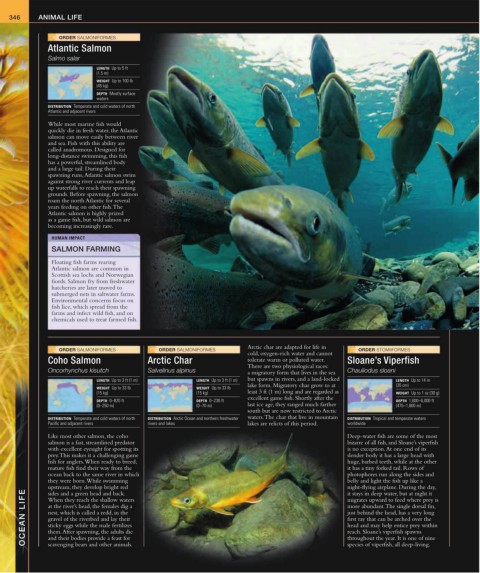
               While most marine fish would
               quickly die in fresh water, the Atlantic
               salmon can move easily between river
               and sea. Fish with this ability are
               called anadromous. Designed for
               long-distance swimming, this fish
               has a powerful, streamlined body
               and a large tail. During their
               spawning runs, Atlantic salmon swim
               against strong river currents and leap
               up waterfalls to reach their spawning
               grounds. Before spawning, the salmon
               roam the north Atlantic for several
               years feeding on other fish. The
               Atlantic salmon is highly prized
               as a game fish, but wild salmon are
               becoming increasingly rare.
                HUMAN IMPACT
                SALMON FARMING
                Floating fish farms rearing
                Atlantic salmon are common in
                Scottish sea lochs and Norwegian
                fiords. Salmon fry from freshwater
                hatcheries are later moved to
                submerged nets in saltwater farms.
                Environmental concerns focus on
                fish lice, which spread from the
                farms and infect wild fish, and on
                chemicals used to treat farmed fish.


                                                                           Arctic char are adapted for life in
                  ORDER SALMONIFORMES           ORDER SALMONIFORMES                                         ORDER STOMIIFORMES
                                                                           cold, oxygen-rich water and cannot
               Coho Salmon                   Arctic Char                   tolerate warm or polluted water.    Sloane’s Viperfish
                                                                           There are two physiological races:
               Oncorhynchus kisutch          Salvelinus alpinus            a migratory form that lives in the sea   Chauliodus sloani
                              LENGTH  Up to 3 ft (1 m)     LENGTH  Up to 3 ft (1 m)  but spawns in rivers, and a land-locked   LENGTH  Up to 14 in
                                                                           lake form. Migratory char grow to at        (35 cm)
                              WEIGHT  Up to 33 lb          WEIGHT  Up to 33 lb
                              (15 kg)                      (15 kg)         least 3 ft (1 m) long and are regarded as   WEIGHT  Up to 1 oz (30 g)
                                                                           excellent game fish. Shortly after the
                              DEPTH  0–820 ft              DEPTH  0–230 ft                                             DEPTH  1,600–6,000 ft
                              (0–250 m)                    (0–70 m)        last ice age, they ranged much farther      (475–1,800 m)
                                                                           south but are now restricted to Arctic
               DISTRIBUTION  Temperate and cold waters of north   DISTRIBUTION  Arctic Ocean and northern freshwater   waters. The char that live in mountain   DISTRIBUTION  Tropical and temperate waters
               Pacific and adjacent rivers    rivers and lakes              lakes are relicts of this period.  worldwide
               Like most other salmon, the coho                                                         Deep-water fish are some of the most
               salmon is a fast, streamlined predator                                                   bizarre of all fish, and Sloane’s viperfish
               with excellent eyesight for spotting its                                                 is no exception. At one end of its
               prey. This makes it a challenging game                                                   slender body it has a large head with
               fish for anglers. When ready to breed,                                                   huge, barbed teeth, while at the other
               mature fish find their way from the                                                      it has a tiny forked tail. Rows of
               ocean back to the same river in which                                                    photophores run along the sides and
               they were born. While swimming                                                           belly and light the fish up like a
               upstream, they develop bright red                                                        night-flying airplane. During the day,
        OCEAN LIFE  at the river’s head, the females dig a                                              more abundant. The single dorsal fin,
               sides and a green head and back.
                                                                                                        it stays in deep water, but at night it
                                                                                                        migrates upward to feed where prey is
               When they reach the shallow waters
                                                                                                        just behind the head, has a very long
               nest, which is called a redd, in the
               gravel of the riverbed and lay their
                                                                                                        first ray that can be arched over the
                                                                                                        head and may help entice prey within
               sticky eggs while the male fertilizes
                                                                                                        reach. Sloane’s viperfish spawns
               them. After spawning, the adults die
                                                                                                        throughout the year. It is one of nine
               and their bodies provide a feast for
                                                                                                        species of viperfish, all deep-living.
               scavenging bears and other animals.

