


Page 372 - (DK) Ocean - The Definitive Visual Guide
P. 372
370     ANIMAL LIFE


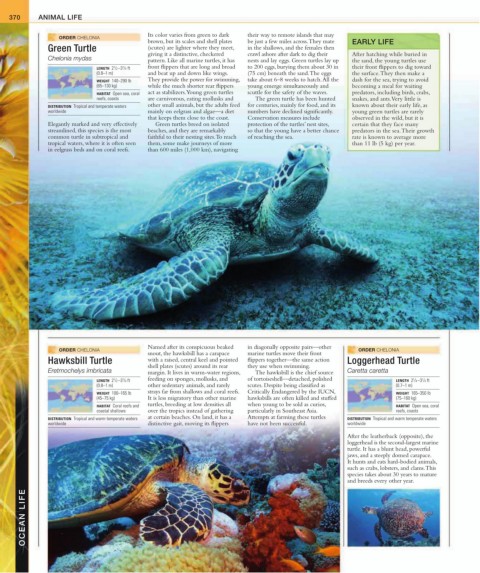
                  ORDER CHELONIA             Its color varies from green to dark   their way to remote islands that may
                                             brown, but its scales and shell plates   be just a few miles across. They mate   EARLY LIFE
               Green Turtle                  (scutes) are lighter where they meet,   in the shallows, and the females then
                                             giving it a distinctive, checkered   crawl ashore after dark to dig their   After hatching while buried in
               Chelonia mydas                pattern. Like all marine turtles, it has   nests and lay eggs. Green turtles lay up   the sand, the young turtles use
                              LENGTH  2 / 2 –3 / 4  ft   front flippers that are long and broad   to 200 eggs, burying them about 30 in   their front flippers to dig toward
                                   1
                                     1
                              (0.8–1 m)      and beat up and down like wings.   (75 cm) beneath the sand. The eggs   the surface. They then make a
                              WEIGHT  140–290 lb   They provide the power for swimming,   take about 6–8 weeks to hatch. All the   dash for the sea, trying to avoid
                              (65–130 kg)    while the much shorter rear flippers   young emerge simultaneously and   becoming a meal for waiting
                              HABITAT  Open sea, coral   act as stabilizers. Young green turtles   scuttle for the safety of the waves.  predators, including birds, crabs,
                              reefs, coasts  are carnivorous, eating mollusks and   The green turtle has been hunted   snakes, and ants. Very little is
               DISTRIBUTION  Tropical and temperate waters   other small animals, but the adults feed   for centuries, mainly for food, and its   known about their early life, as
               worldwide                     mainly on eelgrass and algae—a diet   numbers have declined significantly.   young green turtles are rarely
                                             that keeps them close to the coast.  Conservation measures include   observed in the wild, but it is
               Elegantly marked and very effectively   Green turtles breed on isolated   protection of the turtles’ nest sites,    certain that they face many
               streamlined, this species is the most   beaches, and they are remarkably   so that the young have a better chance    predators in the sea. Their growth
               common turtle in subtropical and   faithful to their nesting sites. To reach   of reaching the sea.  rate is known to average more
               tropical waters, where it is often seen   them, some make journeys of more                 than 11 lb (5 kg) per year.
               in eelgrass beds and on coral reefs.    than 600 miles (1,000 km), navigating


                                             Named after its conspicuous beaked   in diagonally opposite pairs—other
                  ORDER CHELONIA                                                                            ORDER CHELONIA
                                             snout, the hawksbill has a carapace   marine turtles move their front
               Hawksbill Turtle              with a raised, central keel and pointed   flippers together—the same action   Loggerhead Turtle
                                             shell plates (scutes) around its rear   they use when swimming.
                                             margin. It lives in warm-water regions,   The hawksbill is the chief source
               Eretmochelys imbricata                                                                   Caretta caretta
                                     1
                                                                                                                            1
                                                                                                                               1
                              LENGTH  2 / 2 –3 / 4 ft   feeding on sponges, mollusks, and   of tortoiseshell—detached, polished   LENGTH  2 / 4 –3 / 4 ft
                                   1
                              (0.8–1 m)      other sedentary animals, and rarely   scutes. Despite being classified as   (0.7–1 m)
                              WEIGHT  100–165 lb   strays far from shallows and coral reefs.   Critically Endangered by the IUCN,   WEIGHT  165–350 lb
                              (45–75 kg)     It is less migratory than other marine   hawksbills are often killed and stuffed   (75–160 kg)
                              HABITAT  Coral reefs and   turtles, breeding at low densities all   when young to be sold as curios,   HABITAT  Open sea, coral
                              coastal shallows  over the tropics instead of gathering    particularly in Southeast Asia.   reefs, coasts
               DISTRIBUTION  Tropical and warm-temperate waters   at certain beaches. On land, it has a   Attempts at farming these turtles    DISTRIBUTION  Tropical and warm temperate waters
               worldwide                     distinctive gait, moving its flippers    have not been successful.  worldwide
                                                                                                        After the leatherback (opposite), the
                                                                                                        loggerhead is the second-largest marine
                                                                                                        turtle. It has a blunt head, powerful
                                                                                                        jaws, and a steeply domed carapace.
                                                                                                        It hunts and eats hard-bodied animals,
                                                                                                        such as crabs, lobsters, and clams. This
                                                                                                        species takes about 30 years to mature
                                                                                                        and breeds every other year.
        OCEAN LIFE

