


Page 373 - (DK) Ocean - The Definitive Visual Guide
P. 373
REPTILES       371


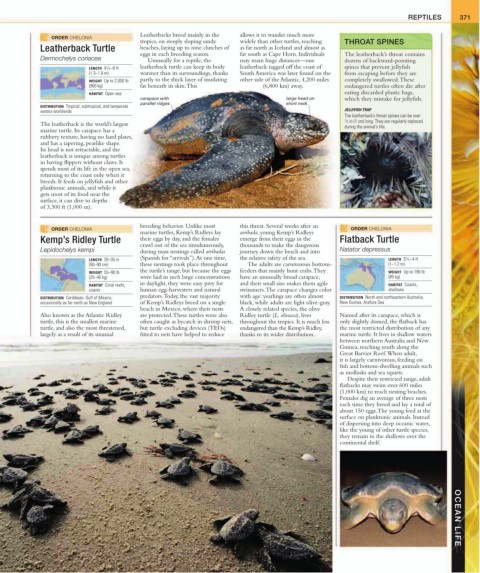
                ORDER CHELONIA             Leatherbacks breed mainly in the   allows it to wander much more
                                           tropics, on steeply sloping sandy   widely than other turtles, reaching    THROAT SPINES
             Leatherback Turtle            beaches, laying up to nine clutches of   as far north as Iceland and almost as
                                           eggs in each breeding season.   far south as Cape Horn. Individuals   The leatherback’s throat contains
             Dermochelys coriacea            Unusually for a reptile, the   may roam huge distances—one   dozens of backward-pointing
                           LENGTH  4 / 4 –6 ft   leatherback turtle can keep its body   leatherback tagged off the coast of   spines that prevent jellyfish
                                 1
                           (1.3–1.8 m)     warmer than its surroundings, thanks   South America was later found on the   from escaping before they are
                           WEIGHT  Up to 2,000 lb    partly to the thick layer of insulating   other side of the Atlantic, 4,200 miles   completely swallowed. These
                           (900 kg)        fat beneath its skin. This          (6,800 km) away.         endangered turtles often die after
                           HABITAT  Open sea                                                            eating discarded plastic bags,
                                           carapace with                              large head on     which they mistake for jellyfish.
                                           parallel ridges                            short neck
             DISTRIBUTION  Tropical, subtropical, and temperate
             waters worldwide                                                                           JELLYFISH TRAP
                                                                                                        The leatherback’s throat spines can be over
                                                                                                        1 / 2 in (1 cm) long. They are regularly replaced
             The leatherback is the world’s largest                                                     during the animal’s life.
             marine turtle. Its carapace has a
             rubbery texture, having no hard plates,
             and has a tapering, pearlike shape.
             Its head is not retractable, and the
             leatherback is unique among turtles
             in having flippers without claws. It
             spends most of its life in the open sea,
             returning to the coast only when it
             breeds. It feeds on jellyfish and other
             planktonic animals, and while it
             gets most of its food near the
             surface, it can dive to depths
             of 3,300 ft (1,000 m).


                                           breeding behavior. Unlike most   this threat. Several weeks after an
                ORDER CHELONIA                                                                           ORDER CHELONIA
                                           marine turtles, Kemp’s Ridleys lay   arribada, young Kemp’s Ridleys
             Kemp’s Ridley Turtle          their eggs by day, and the females   emerge from their eggs in the   Flatback Turtle
                                           crawl out of the sea simultaneously,   thousands to make the dangerous
                                           during mass nestings called arribadas   journey down the beach and into    Natator depressus
             Lepidochelys kempi
                                           (Spanish for “arrivals”). At one time,   the relative safety of the sea.
                                                                                                                          1
                           LENGTH  20–35 in                                                                          LENGTH  3 / 4 –4 ft
                           (50–90 cm)      these nestings took place throughout   The adults are carnivorous bottom-  (1–1.2 m)
                                           the turtle’s range, but because the eggs   feeders that mainly hunt crabs. They
                           WEIGHT  55–90 lb                                                                          WEIGHT  Up to 190 lb
                           (25–40 kg)      were laid in such large concentrations   have an unusually broad carapace,    (85 kg)
                                           in daylight, they were easy prey for   and their small size makes them agile
                           HABITAT  Coral reefs,                                                                     HABITAT  Coasts,
                           coasts          human egg-harvesters and natural   swimmers. The carapace changes color   shallows
             DISTRIBUTION  Caribbean, Gulf of Mexico,   predators. Today, the vast majority    with age: yearlings are often almost   DISTRIBUTION  North and northeastern Australia,
             occasionally as far north as New England  of Kemp’s Ridleys breed on a single   black, while adults are light olive-gray.   New Guinea, Arafura Sea
                                           beach in Mexico, where their nests    A closely related species, the olive
             Also known as the Atlantic Ridley   are protected. These turtles were also   Ridley turtle (L. olivacea), lives   Named after its carapace, which is
             turtle, this is the smallest marine    often caught as bycatch in shrimp nets,  throughout the tropics. It is much less   only slightly domed, the flatback has
             turtle, and also the most threatened,   but turtle excluding devices (TEDs)   endangered than the Kemp’s Ridley,   the most restricted distribution of any
             largely as a result of its unusual   fitted to nets have helped to reduce   thanks to its wider distribution.  marine turtle. It lives in shallow waters
                                                                                                      between northern Australia and New
                                                                                                      Guinea, reaching south along the
                                                                                                      Great Barrier Reef. When adult,
                                                                                                      it is largely carnivorous, feeding on
                                                                                                      fish and bottom-dwelling animals such
                                                                                                      as mollusks and sea squirts.
                                                                                                        Despite their restricted range, adult
                                                                                                      flatbacks may swim over 600 miles
                                                                                                      (1,000 km) to reach nesting beaches.
                                                                                                      Females dig an average of three nests
                                                                                                      each time they breed and lay a total of
                                                                                                      about 150 eggs. The young feed at the
                                                                                                      surface on planktonic animals. Instead
                                                                                                      of dispersing into deep oceanic water,
                                                                                                      like the young of other turtle species,
                                                                                                      they remain in the shallows over the
                                                                                                      continental shelf.                 OCEAN LIFE

