


Page 411 - (DK) Ocean - The Definitive Visual Guide
P. 411
409


                ORDER CETACEA
             Minke Whale

             Balaenoptera acutorostrata
                           LENGTH  23–33 ft
                           (7–10 m)
                           WEIGHT  5–11 tons
                           (5–10 metric tons)
                           HABITAT  Open ocean
                           and coastal waters
             DISTRIBUTION  Worldwide, except extreme north
             and south

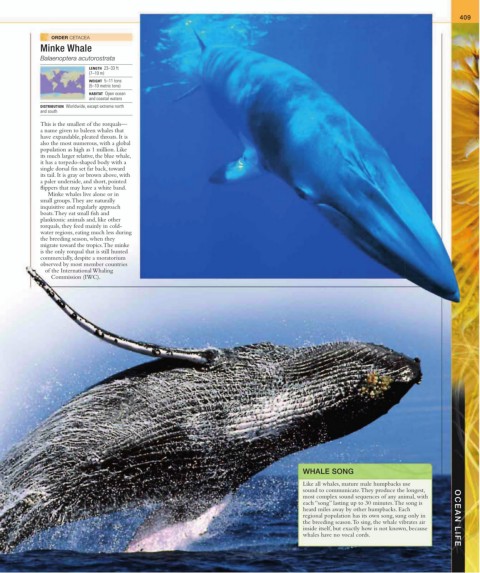
             This is the smallest of the rorquals—
             a name given to baleen whales that
             have expandable, pleated throats. It is
             also the most numerous, with a global
             population as high as 1 million. Like
             its much larger relative, the blue whale,
             it has a torpedo-shaped body with a
             single dorsal fin set far back, toward
             its tail. It is gray or brown above, with
             a paler underside, and short, pointed
             flippers that may have a white band.
               Minke whales live alone or in
             small groups. They are naturally
             inquisitive and regularly approach
             boats. They eat small fish and
             planktonic animals and, like other
             rorquals, they feed mainly in cold-
             water regions, eating much less during
             the breeding season, when they
             migrate toward the tropics. The minke
             is the only rorqual that is still hunted
             commercially, despite a moratorium
             observed by most member countries
              of the International Whaling
                Commission (IWC).


                                                                                           WHALE SONG

                                                                                           Like all whales, mature male humpbacks use
                                                                                           sound to communicate. They produce the longest,
                                                                                           most complex sound sequences of any animal, with
                                                                                           each “song” lasting up to 30 minutes. The song is
                                                                                           heard miles away by other humpbacks. Each
                                                                                           regional population has its own song, sung only in   OCEAN LIFE
                                                                                           the breeding season. To sing, the whale vibrates air
                                                                                           inside itself, but exactly how is not known, because
                                                                                           whales have no vocal cords.

