


Page 408 - (DK) Ocean - The Definitive Visual Guide
P. 408
406 ANIMAL LIFE
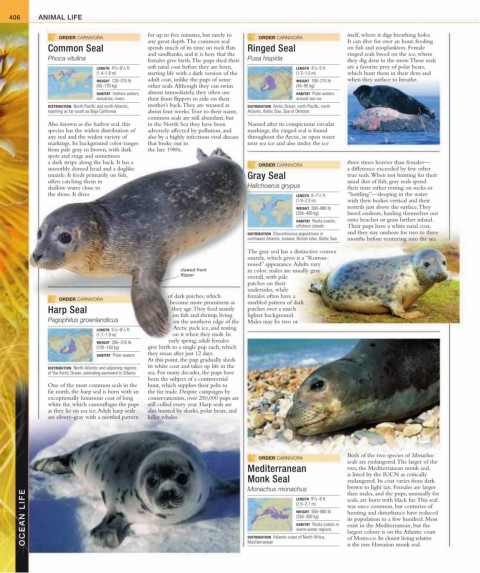
ORDER CARNIVORA for up to five minutes, but rarely to ORDER CARNIVORA itself, where it digs breathing holes.
any great depth. The common seal It can dive for over an hour, feeding
Common Seal spends much of its time on rock flats Ringed Seal on fish and zooplankton. Female
and sandbanks, and it is here that the ringed seals breed on the ice, where
Phoca vitulina females give birth. The pups shed their Pusa hispida they dig dens in the snow. These seals
LENGTH 4 / 5–6 / 4 ft soft natal coat before they are born, LENGTH 4 / 4–5 ft are a favorite prey of polar bears,
1
1
3
(1.4–1.9 m) starting life with a dark version of the (1.3–1.5 m) which hunt them in their dens and
WEIGHT 120–375 lb adult coat, unlike the pups of some WEIGHT 100–210 lb when they surface to breathe.
(55–170 kg) other seals. Although they can swim (45–95 kg)
HABITAT Inshore waters, almost immediately, they often use HABITAT Polar waters
estuaries, rivers their front flippers to ride on their around sea ice
DISTRIBUTION North Pacific and north Atlantic, mother’s back. They are weaned at DISTRIBUTION Arctic Ocean, north Pacific, north
reaching as far south as Baja California about four weeks. True to their name, Atlantic, Baltic Sea, Sea of Okhotsk
common seals are still abundant, but
Also known as the harbor seal, this in the North Sea they have been Named after its conspicuous circular
species has the widest distribution of adversely affected by pollution, and markings, the ringed seal is found
any seal and the widest variety of also by a highly infectious viral disease throughout the Arctic, in open water
markings. Its background color ranges that broke out in near sea ice and also under the ice
from pale gray to brown, with dark the late 1980s.
spots and rings and sometimes
a dark stripe along the back. It has a ORDER CARNIVORA three times heavier than females—
smoothly domed head and a doglike a difference exceeded by few other
muzzle. It feeds primarily on fish, Gray Seal true seals. When not hunting for their
often catching them in usual diet of fish, gray seals spend
shallow water close to Halichoerus grypus their time either resting on rocks or
the shore. It dives LENGTH 6–7 / 2 ft “bottling”—sleeping in the water
1
(1.8–2.3 m) with their bodies vertical and their
WEIGHT 550–880 lb nostrils just above the surface. They
(250–400 kg) breed onshore, hauling themselves out
HABITAT Rocky coasts, onto beaches or grass farther inland.
offshore islands Their pups have a white natal coat,
DISTRIBUTION Discontinuous populations in and they stay onshore for two to three
northwest Atlantic, Iceland, British Isles, Baltic Sea months before venturing into the sea.
The gray seal has a distinctive convex
muzzle, which gives it a “Roman-
nosed” appearance. Adults vary
clawed front in color: males are usually gray
flipper
overall, with pale
patches on their
undersides, while
of dark patches, which females often have a
ORDER CARNIVORA
become more prominent as marbled pattern of dark
Harp Seal they age. They feed mainly patches over a much
on fish and shrimp, living lighter background.
on the southern edge of the Males may be two or
Pagophilus groenlandicus
LENGTH 5 / 2–6 / 4 ft Arctic pack ice, and resting
1
1
(1.7–1.9 m) on it when they molt. In
WEIGHT 265–310 lb early spring, adult females
(120–140 kg) give birth to a single pup each, which
HABITAT Polar waters they wean after just 12 days.
At this point, the pup gradually sheds
DISTRIBUTION North Atlantic and adjoining regions its white coat and takes up life in the
of the Arctic Ocean, extending eastward to Siberia sea. For many decades, the pups have
been the subject of a controversial
One of the most common seals in the hunt, which supplies their pelts to
far north, the harp seal is born with an the fur trade. Despite campaigns by
exceptionally luxurious coat of long conservationists, over 250,000 pups are
white fur, which camouflages the pups still culled every year. Harp seals are
as they lie on sea ice. Adult harp seals also hunted by sharks, polar bears, and
are silvery-gray with a mottled pattern killer whales.
ORDER CARNIVORA Both of the two species of Monachus
seals are endangered. The larger of the
Mediterranean two, the Mediterranean monk seal,
is listed by the IUCN as critically
Monk Seal endangered. Its coat varies from dark
brown to light tan. Females are larger
OCEAN LIFE DISTRIBUTION Atlantic coast of North Africa, was once common, but centuries of
than males, and the pups, unusually for
Monachus monachus
1
LENGTH 8 / 4–9 ft
seals, are born with black fur. This seal
(2.5–2.7 m)
WEIGHT 550–660 lb
hunting and disturbance have reduced
(250–300 kg)
its population to a few hundred. Most
HABITAT Rocky coasts in
exist in the Mediterranean, but the
warm-water regions
largest colony is on the Atlantic coast
of Morocco. Its closest living relative
Mediterranean
is the rare Hawaiian monk seal.

