


Page 410 - (DK) Ocean - The Definitive Visual Guide
P. 410
408     ANIMAL LIFE


                  ORDER CETACEA              with a total population of about 500
                                             individuals. A deep bluish black, apart
               Northern                      from white markings on its belly, it has
                                             a deeply arched mouth, with a lower
               Right Whale                   jaw shaped like a gigantic scoop. Its
                                             head its covered with distinctive areas
                                             of hard pale skin, known as callosities,
               Eubalaena glacialis
                              LENGTH  43–56 ft   which scientists use to identify
                              (13–17 m)
                                             individuals. Like all baleen whales, it
                              WEIGHT  33–88 tons    feeds by filtering food from seawater,
                              (30–80 metric tons)
                                             using brushlike strips of baleen that
                              HABITAT  Temperate and   hang from its upper jaw. Northern
                              subpolar waters
                                             right whales feed at high latitudes, but
               DISTRIBUTION  Northwestern Atlantic, vestigial   they migrate to warmer waters to
               populations in northeastern Atlantic and Pacific
                                             breed. An almost identical species, the
                                             southern right whale, is found in
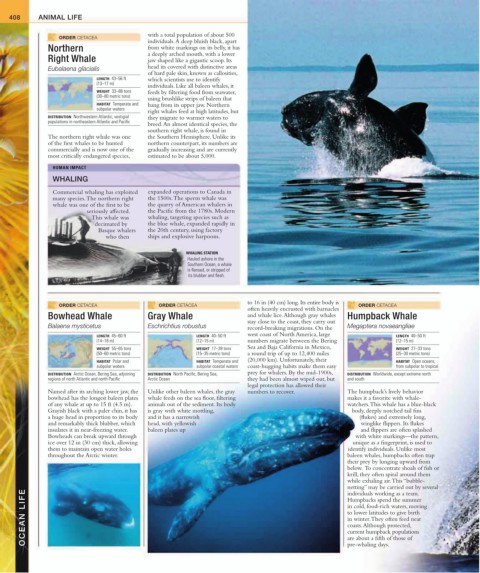
               The northern right whale was one    the Southern Hemisphere. Unlike its
               of the first whales to be hunted   northern counterpart, its numbers are
               commercially and is now one of the   gradually increasing and are currently
               most critically endangered species,   estimated to be about 5,000.
                 HUMAN IMPACT
                 WHALING
                 Commercial whaling has exploited   expanded operations to Canada in
                 many species. The northern right   the 1500s. The sperm whale was
                 whale was one of the first to be   the quarry of American whalers in
                           seriously affected.   the Pacific from the 1780s. Modern
                            This whale was   whaling, targeting species such as
                             decimated by    the blue whale, expanded rapidly in
                              Basque whalers   the 20th century, using factory
                                who then     ships and explosive harpoons.

                                                        WHALING STATION
                                                         Hauled ashore in the
                                                         Southern Ocean, a whale
                                                         is flensed, or stripped of
                                                         its blubber and flesh.


                  ORDER CETACEA                 ORDER CETACEA              to 16 in (40 cm) long. Its entire body is   ORDER CETACEA
                                                                           often heavily encrusted with barnacles
               Bowhead Whale                 Gray Whale                    and whale lice. Although gray whales   Humpback Whale
                                                                           stay close to the coast, they carry out
                                                                           record-breaking migrations. On the
               Balaena mysticetus            Eschrichtius robustus                                      Megaptera novaeangliae
                              LENGTH  45–60 ft             LENGTH  40–50 ft   west coast of North America, large       LENGTH  40–50 ft
                              (14–18 m)                    (12–15 m)       numbers migrate between the Bering          (12–15 m)
                              WEIGHT  55–65 tons           WEIGHT  17–39 tons   Sea and Baja California in Mexico,     WEIGHT  27–33 tons
                              (50–60 metric tons)          (15–35 metric tons)  a round trip of up to 12,400 miles     (25–30 metric tons)
                              HABITAT  Polar and           HABITAT  Temperate and   (20,000 km). Unfortunately, their   HABITAT  Open oceans,
                              subpolar waters              subpolar coastal waters  coast-hugging habits make them easy   from subpolar to tropical
               DISTRIBUTION  Arctic Ocean, Bering Sea, adjoining   DISTRIBUTION  North Pacific, Bering Sea,    prey for whalers. By the mid-1900s,   DISTRIBUTION  Worldwide, except extreme north
               regions of north Atlantic and north Pacific  Arctic Ocean    they had been almost wiped out, but   and south
                                                                           legal protection has allowed their
               Named after its arching lower jaw, the   Unlike other baleen whales, the gray   numbers to recover.  The humpback’s lively behavior
               bowhead has the longest baleen plates   whale feeds on the sea floor, filtering          makes it a favorite with whale-
               of any whale at up to 15 ft (4.5 m).   animals out of the sediment. Its body             watchers. This whale has a blue-black
               Grayish black with a paler chin, it has   is gray with white mottling,                     body, deeply notched tail fins
               a huge head in proportion to its body   and it has a narrowish                               (flukes) and extremely long,
               and remarkably thick blubber, which   head, with yellowish                                   winglike flippers. Its flukes
               insulates it in near-freezing water.   baleen plates up                                      and flippers are often splashed
               Bowheads can break upward through                                                           with white markings—the pattern,
               ice over 12 in (30 cm) thick, allowing                                                     unique as a fingerprint, is used to
               them to maintain open water holes                                                         identify individuals. Unlike most
               throughout the Arctic winter.                                                            baleen whales, humpbacks often trap
                                                                                                        their prey by lunging upward from
                                                                                                        below.  To concentrate shoals of fish or
                                                                                                        krill, they often spiral around them
                                                                                                        while exhaling air. This “bubble-
                                                                                                        netting” may be carried out by several
        OCEAN LIFE                                                                                      in cold, food-rich waters, moving
                                                                                                        individuals working as a team.
                                                                                                        Humpbacks spend the summer
                                                                                                        to lower latitudes to give birth
                                                                                                        in winter. They often feed near
                                                                                                        coasts. Although protected,
                                                                                                        current humpback populations
                                                                                                        are about a fifth of those of
                                                                                                        pre-whaling days.

