


Page 409 - (DK) Ocean - The Definitive Visual Guide
P. 409
MAMMALS         407


                                                                            ORDER CARNIVORA
                                                                                                        FIGHTING MALES
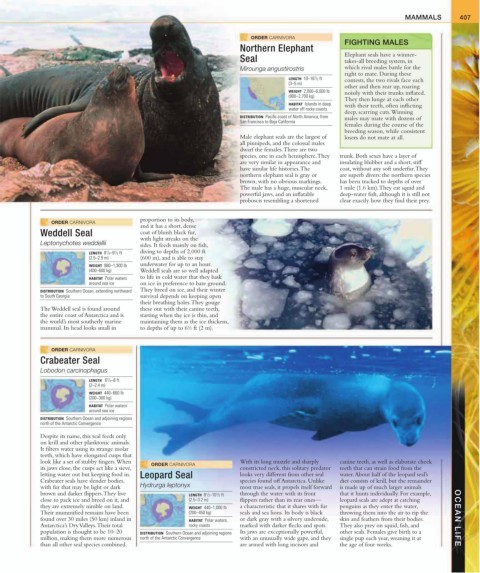
                                                                        Northern Elephant
                                                                                                        Elephant seals have a winner-
                                                                        Seal                            takes-all breeding system, in
                                                                                                        which rival males battle for the
                                                                        Mirounga angustirostris
                                                                                                        right to mate. During these
                                                                                               1
                                                                                       LENGTH  10–16 / 2 ft   contests, the two rivals face each
                                                                                       (3–5 m)
                                                                                                        other and then rear up, roaring
                                                                                       WEIGHT  2,000–6,000 lb   noisily with their trunks inflated.
                                                                                       (900–2,700 kg)
                                                                                                        They then lunge at each other
                                                                                       HABITAT  Islands in deep   with their teeth, often inflicting
                                                                                       water off rocky coasts
                                                                                                        deep, scarring cuts. Winning
                                                                        DISTRIBUTION  Pacific coast of North America, from   males may mate with dozens of
                                                                        San Francisco to Baja California
                                                                                                        females during the course of the
                                                                                                        breeding season, while consistent
                                                                        Male elephant seals are the largest of   losers do not mate at all.
                                                                        all pinnipeds, and the colossal males
                                                                        dwarf the females. There are two
                                                                        species, one in each hemisphere. They   trunk. Both sexes have a layer of
                                                                        are very similar in appearance and   insulating blubber and a short, stiff
                                                                        have similar life histories. The   coat, without any soft underfur. They
                                                                        northern elephant seal is gray or   are superb divers: the northern species
                                                                        brown, with no obvious markings.    has been tracked to depths of over
                                                                        The male has a huge, muscular neck,   1 mile (1.6 km). They eat squid and
                                                                        powerful jaws, and an inflatable   deep-water fish, although it is still not
                                                                        proboscis resembling a shortened   clear exactly how they find their prey.
                                           proportion to its body,
                ORDER CARNIVORA
                                           and it has a short, dense
             Weddell Seal                  coat of bluish black fur,
                                           with light streaks on the
                                           sides. It feeds mainly on fish,
             Leptonychotes weddellii
                                 1
                                   1
                           LENGTH  8 / 4–9 / 2 ft   diving to depths of 2,000 ft
                           (2.5–2.9 m)     (600 m), and is able to stay
                           WEIGHT  880–1,300 lb   underwater for up to an hour.
                           (400–600 kg)    Weddell seals are so well adapted
                           HABITAT  Polar waters   to life in cold water that they bask
                           around sea ice  on ice in preference to bare ground.
             DISTRIBUTION  Southern Ocean, extending northward   They breed on ice, and their winter
             to South Georgia              survival depends on keeping open
                                           their breathing holes. They gouge
             The Weddell seal is found around    these out with their canine teeth,
             the entire coast of Antarctica and is   starting when the ice is thin, and
             the world’s most southerly marine   maintaining them as the ice thickens,
             mammal. Its head looks small in   to depths of up to 6/2 ft (2 m).
                                                         1

                ORDER CARNIVORA
             Crabeater Seal

             Lobodon carcinophagus
                                 1
                           LENGTH   6 / 2–8 ft
                           (2–2.4 m)
                           WEIGHT  440–660 lb
                           (200–300 kg)
                           HABITAT  Polar waters
                           around sea ice
             DISTRIBUTION  Southern Ocean and adjoining regions
             north of the Antarctic Convergence
             Despite its name, this seal feeds only
             on krill and other planktonic animals.
             It filters water using its strange molar
             teeth, which have elongated cusps that
             look like a set of stubby fingers. When   ORDER CARNIVORA  With its long muzzle and sharply   canine teeth, as well as elaborate cheek
             its jaws close, the cusps act like a sieve,                constricted neck, this solitary predator   teeth that can strain food from the
             letting water out but keeping food in.   Leopard Seal      looks very different from other seal   water. About half of the leopard seal’s
             Crabeater seals have slender bodies,                       species found off Antarctica. Unlike   diet consists of krill, but the remainder
             with fur that may be light or dark   Hydrurga leptonyx     most true seals, it propels itself forward   is made up of much larger animals
             brown and darker flippers. They live        LENGTH  8 / 2–10 / 2 ft   through the water with its front   that it hunts individually. For example,
                                                                 1
                                                              1
             close to pack ice and breed on it, and      (2.5–3.2 m)    flippers rather than its rear ones—   leopard seals are adept at catching
             they are extremely nimble on land.          WEIGHT  440–1,000 lb   a characteristic that it shares with fur   penguins as they enter the water,
             Their mummified remains have been           (200–450 kg)   seals and sea lions. Its body is black    throwing them into the air to rip the
             found over 30 miles (50 km) inland in       HABITAT  Polar waters,   or dark gray with a silvery underside,   skin and feathers from their bodies.   OCEAN LIFE
             Antarctica’s Dry Valleys. Their total       rocky coasts   marked with darker flecks and spots.   They also prey on squid, fish, and
             population is thought to be 10–20   DISTRIBUTION  Southern Ocean and adjoining regions   Its jaws are exceptionally powerful,   other seals. Females give birth to a
             million, making them more numerous   north of the Antarctic Convergence  with an unusually wide gape, and they   single pup each year, weaning it at
             than all other seal species combined.                      are armed with long incisors and   the age of four weeks.

