


Page 430 - (DK) Ocean - The Definitive Visual Guide
P. 430
428 THE ATLANTIC OCEAN A B C
90ºW 60ºW
The Atlantic Baffin
1 B a f f i n I s l a n d
Ocean Arctic Circle Basin
Foxe
THE ATLANTIC SEPARATES the “old world” of Europe 60ºN Hudson Hudson
Bay
and North Africa from the “new world” of the Americas.
The Portuguese pioneered the ocean’s exploration, with NOR TH
Bartolomeu Dias reaching Africa’s southern tip in 1488,
2
but a Spanish expedition AMERICA
Great Québec
St Lawrence
led by Christopher Lakes Montréal
Columbus was the first to Detroit Toronto
Chicago
cross the Atlantic to reach New York
Baltimore
the West Indies in 1492.
ATLANTIC SURF Mississippi
BATTERS BERMUDA 30ºN Rio Grande Blake
3 Plateau Hatteras
New Orleans Tampa Plain
Ocean Circulation Tropic of Cancer Gulf of Miami
Havana
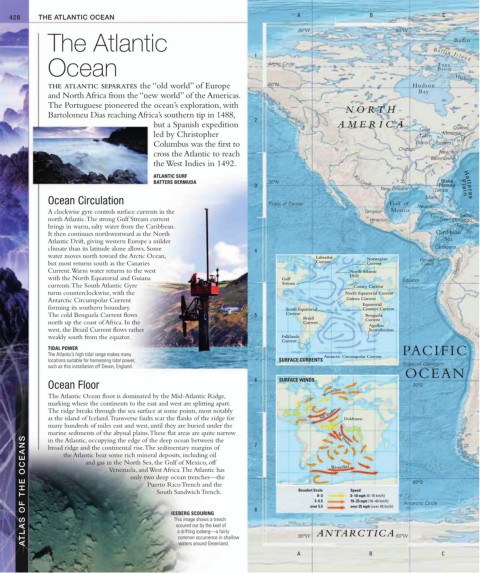
A clockwise gyre controls surface currents in the Tampico Mexico
Santo
north Atlantic. The strong Gulf Stream current Veracruz Domingo
brings in warm, salty water from the Caribbean. Greater Antilles
It then continues northwestward as the North Caribbean
Atlantic Drift, giving western Europe a milder Sea
climate than its latitude alone allows. Some 4 Cartagena
water moves north toward the Arctic Ocean, Labrador Norwegian Panama
but most returns south as the Canaries Current Current Canal Magdalena
Current. Warm water returns to the west North Atlantic
with the North Equatorial and Guiana Gulf Drift Equator
currents. The South Atlantic Gyre Stream Canary Current
turns counterclockwise, with the North Equatorial Current
Antarctic Circumpolar Current Guinea Current
Equatorial
forming its southern boundary. South Equatorial Counter Current
The cold Benguela Current flows 5 Current Brazil Benguela
north up the coast of Africa. In the Current Current
Agulhas
west, the Brazil Current flows rather Retroflection
weakly south from the equator. Falklands
Current
TIDAL POWER PACIFIC
The Atlantic’s high tidal range makes many Antarctic Circumpolar Current
locations suitable for harnessing tidal power, SURFACE CURRENTS
Tropic of Capricorn
such as this installation off Devon, England.
OCEAN
6 SURFACE WINDS
Ocean Floor 30ºS
The Atlantic Ocean floor is dominated by the Mid-Atlantic Ridge, Westerlies
marking where the continents to the east and west are splitting apart.
The ridge breaks through the sea surface at some points, most notably NE Trades
as the island of Iceland. Transverse faults scar the flanks of the ridge for Doldrums
many hundreds of miles east and west, until they are buried under the
marine sediments of the abyssal plains. These flat areas are quite narrow 7 SE Trades
ATLAS OF THE OCEANS and gas in the North Sea, the Gulf of Mexico, off 8 Beaufort Scale Westerlies Speed Antarctic Circle
in the Atlantic, occupying the edge of the deep ocean between the
broad ridge and the continental rise. The sedimentary margins of
the Atlantic bear some rich mineral deposits, including oil
Venezuela, and West Africa. The Atlantic has
only two deep ocean trenches—the
60ºS
Puerto Rico Trench and the
South Sandwich Trench.
0–3
0–10 mph (0–16 km/h)
3–5.5
10–25 mph (16–40 km/h)
over 5.5
over 25 mph (over 40 km/h)
ICEBERG SCOURING
This image shows a trench
scoured out by the keel of
a drifting iceberg—a fairly
common occurrence in shallow
waters around Greenland.
B
A 90ºW ANTARCTICA 60ºW C

