


Page 462 - (DK) Ocean - The Definitive Visual Guide
P. 462
460 THE PACIFIC OCEAN A B
120˚E
The Northwestern HUMAN IMPACT 60˚N KEY
OIL EXPLORATION sea level
Pacific A rush to exploit rich oil and gas 1 800 ft
deposits on the island of Sakhalin (250 m)
LIKE THE BERING SEA TO THE NORTHEAST, this part of the Island started in 1996. The area 1,600 ft
Pacific is shaped by subduction at the edge of the Pacific Plate. is now the largest recipient of (500 m)
3,300 ft
Volcanoes, earthquakes, and tsunamis present a risk to human foreign investment in Russia, (1,000 m)
and oil production is expanding
6,500 ft
life, particularly in the densely populated islands of Japan. offshore into the Sea of Okhotsk. (2,000 m)
The large amount of construction 9,800 ft
Islands, and linked in the south to the
PACIFIC OCEAN E4 in such a short time has raised (3,000 m)
Sea of Japan/East Sea by two narrow concerns about the impact on 2 16,400 ft
Sea of Okhotsk straits. Navigation of the sea is restricted this wilderness environment, (5,000 m)
by sea ice in the winter, when ice including disturbance of the
AREA 600,000 square miles (1.6 million square km) formation on ship hulls also presents marine life of the Sea of Okhotsk. land
MAXIMUM DEPTH 11,063 ft (3,372 m) a danger to shipping. The southern
part of the sea is notorious for its sea seamount
INFLOWS Sea of Japan/East Sea; Amur, Uda,
Okhota, Penzhina rivers fogs throughout the year. The Sea of sea depth
Okhotsk is very productive, accounting maximum depth
A subarctic shelf sea, the Sea for nearly 70 percent of Russia’s East on map
of Okhotsk is a branch of the Asian fish catch. It is home to several tectonic plate
northwestern Pacific. It is enclosed endangered species of marine life, boundary
to the north by the Asian landmass, including Kurile harbor seals and gray 3
bounded to the east by the Kurile whales. The Okhotsk Plate includes
the continental crust of the Kamchatka
Peninsula, with its string of volcanoes,
and the islands of Sakhalin and
Hokkaido. In much of the area, the sea 50˚N
floor is quite shallow, but it is deeper
in the Kurile Basin, where the ocean
crust has stretched and thinned.
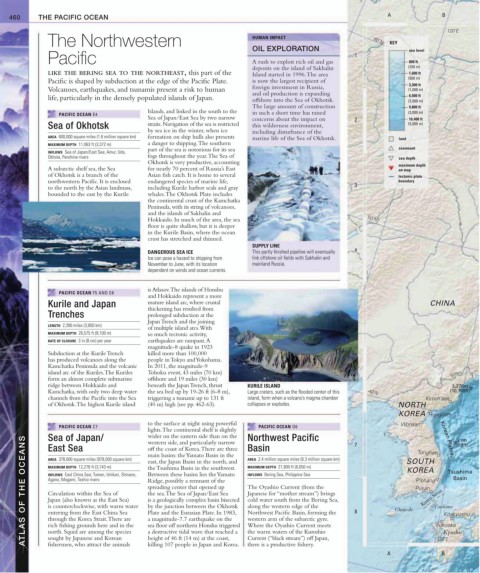
SUPPLY LINE
DANGEROUS SEA ICE This partly finished pipeline will eventually 4
Ice can pose a hazard to shipping from link offshore oil fields with Sakhalin and
November to June, with its location mainland Russia.
dependent on winds and ocean currents.
is Atlasov. The islands of Honshu
PACIFIC OCEAN F5 AND E8
and Hokkaido represent a more
Kurile and Japan mature island arc, where crustal CHINA
thickening has resulted from
Trenches prolonged subduction at the
Japan Trench and the joining
LENGTH 2,390 miles (3,850 km)
of multiple island arcs. With
MAXIMUM DEPTH 26,575 ft (8,100 m) so much tectonic activity,
RATE OF CLOSURE 3 in (8 cm) per year earthquakes are rampant. A
magnitude-8 quake in 1923
Subduction at the Kurile Trench killed more than 100,000
has produced volcanoes along the people in Tokyo and Yokohama.
Kamchatka Peninsula and the volcanic In 2011, the magnitude-9
island arc of the Kuriles. The Kuriles Tohoku event, 43 miles (70 km) Tumen
form an almost complete submarine offshore and 19 miles (30 km)
ridge between Hokkaido and beneath the Japan Trench, thrust KURILE ISLAND 3,276m
Kamchatka, with only two deep water the sea bed up by 19-26 ft (6-8 m), Large craters, such as the flooded center of this 40˚N (10,749ft)
channels from the Pacific into the Sea triggering a tsunami up to 131 ft island, form when a volcano’s magma chamber Kimch’aek
of Okhotsk. The highest Kurile island (40 m) high (see pp. 462-63). collapses or explodes. NORTH
KOREA Hungnam
to the surface at night using powerful Wonsan
PACIFIC OCEAN C7 PACIFIC OCEAN G6
lights. The continental shelf is slightly Northwest Pacific 7 Tonghae Korean Plateau (69ft)
Sea of Japan/
wider on the eastern side than on the
ATLAS OF THE OCEANS MAXIMUM DEPTH 12,276 ft (3,743 m) east, the Japan Basin in the north, and MAXIMUM DEPTH 21,800 ft (6,650 m) 8 Cheju-do Pusan Tsushima Basin
21m
western side, and particularly narrow
East Sea
Basin
off the coast of Korea. There are three
main basins: the Yamato Basin in the
AREA 2.4 million square miles (6.3 million square km)
AREA 378,000 square miles (978,000 square km)
SOUTH
the Tsushima Basin in the southwest.
KOREA
Tsushima
Between these basins lies the Yamato
INFLOWS East China Sea; Tumen, Ishikari, Shinano,
INFLOWS Bering Sea, Philippine Sea
Agano, Mogami, Teshio rivers
P’ohang
Ridge, possibly a remnant of the
The Oyashio Current (from the
spreading center that opened up
Korea Strait
the sea. The Sea of Japan/East Sea
Japanese for “mother stream”) brings
Circulation within the Sea of
is a geologically complex basin bisected
Japan (also known as the East Sea)
cold water south from the Bering Sea,
is counterclockwise, with warm water
by the junction between the Okhotsk
along the western edge of the
Plate and the Eurasian Plate. In 1983,
entering from the East China Sea
Northwest Pacific Basin, forming the
Kitakyushu
a magnitude-7.7 earthquake on the
through the Korea Strait. There are
western arm of the subarctic gyre.
rich fishing grounds here and in the
Where the Oyashio Current meets
sea floor off northern Honshu triggered
north. Squid are among the species
Kyushu
a destructive tidal wave that reached a
the warm waters of the Kuroshio
height of 46 ft (14 m) at the coast,
sought by Japanese and Korean
Current (“black stream”) off Japan,
130˚E
there is a productive fishery.
fishermen, who attract the animals
killing 107 people in Japan and Korea.
B
A Fukuoka

