


Page 465 - (DK) Ocean - The Definitive Visual Guide
P. 465
463


                                     Tohuku Tsunami


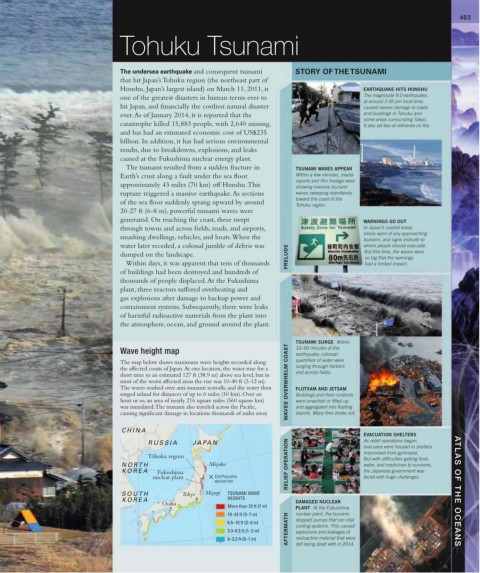
                                     The undersea earthquake and consequent tsunami
                                                                                         STORY OF THE TSUNAMI
                                     that hit Japan’s Tohuku region (the northeast part of
                                     Honshu, Japan’s largest island) on March 11, 2011, is                   EARTHQUAKE HITS HONSHU
                                     one of the greatest disasters in human terms ever to                    The magnitude 9.0 earthquake,
                                                                                                             at around 2:45 pm local time,
                                     hit Japan, and financially the costliest natural disaster               caused severe damage to roads
                                     ever. As of January 2014, it is reported that the                       and buildings in Tohuku and
                                                                                                             some areas surrounding Tokyo.
                                     catastrophe killed 15,883 people, with 2,640 missing,                   It also set two oil refineries on fire.
                                     and has had an estimated economic cost of US$235
                                     billion. In addition, it has had serious environmental
                                     results, due to breakdowns, explosions, and leaks
                                     caused at the Fukushima nuclear energy plant.
                                      The tsunami resulted from a sudden fracture in     TSUNAMI WAVES APPEAR
                                     Earth’s crust along a fault under the sea floor     Within a few minutes, media
                                                                                         reports and film footage were
                                     approximately 43 miles (70 km) off Honshu. This     showing massive tsunami
                                     rupture triggered a massive earthquake. As sections    waves sweeping relentlessly
                                                                                         toward the coast of the
                                     of the sea floor suddenly sprang upward by around
                                                                                         Tohuku region.
                                     20–27 ft (6-8 m), powerful tsunami waves were
                                     generated. On reaching the coast, these swept                           WARNINGS GO OUT
                                     through towns and across fields, roads, and airports,                   In Japan’s coastal areas,
                                                                                                             sirens warn of any approaching
                                     smashing dwellings, vehicles, and boats. When the
                                                                                                             tsunami, and signs indicate to
                                     water later receded, a colossal jumble of debris was                    where people should evacuate.
                                     dumped on the landscape.                          PRELUDE               But this time, the waves were
                                                                                                              so big that the warnings
                                      Within days, it was apparent that tens of thousands                     had a limited impact.
                                     of buildings had been destroyed and hundreds of
                                     thousands of people displaced. At the Fukushima
                                     plant, three reactors suffered overheating and
                                     gas explosions after damage to backup power and
                                     containment systems. Subsequently, there were leaks
                                     of harmful radioactive materials from the plant into
                                     the atmosphere, ocean, and ground around the plant.

                                                                                         TSUNAMI SURGE  Within
                                     Wave height map                                     10–50 minutes of the
                                                                                         earthquake, colossal
                                     The map below shows maximum wave heights recorded along   quantities of water were
                                     the affected coasts of Japan. At one location, the water rose for a   surging through harbors
                                     short time to an estimated 127 ft (38.9 m) above sea level, but in   and across fields.
                                     most of the worst affected areas the rise was 10-40 ft (3-12 m).   WAVES OVERWHELM COAST
                                     The waves washed over anti-tsunami seawalls, and the water then   FLOTSAM AND JETSAM
                                     surged inland for distances of up to 6 miles (10 km). Over an   Buildings and their contents
                                     hour or so, an area of nearly 216 square miles (560 square km)   were smashed or lifted up
                                     was inundated. The tsunami also traveled across the Pacific,   and aggregated into floating
                                     causing significant damage in locations thousands of miles away.  islands. Many fires broke out.


                                     CHINA
                                                                                                             EVACUATION SHELTERS
                                             RUSSIA       JA PA N                                            As relief operations began,
                                                                                                             evacuees were housed in shelters
                                             To ¯hoku region                                                 improvised from gymnasia.
                                                                                                             But with difficulties getting food,
                                     NOR TH                    Miyako                  RELIEF OPERATION      water, and medicines to survivors,
                                     K OREA     Fukushima                                                    the Japanese government was
                                              nuclear plant      Earthquake                                  faced with huge challenges.
                                                                 epicenter

                                     SOUTH             Tokyo  Miyagi  TSUNAMI WAVE                                                       ATLAS OF THE OCEANS
                                     K OREA                          HEIGHTS             DAMAGED NUCLEAR
                                                 Osaka
                                                                     More than 23 ft (7 m)  PLANT  At the Fukushima
                                                                     10–23 ft (3–7 m)    nuclear plant, the tsunami
                                                                                       AFTERMATH
                                                                     6.5–10 ft (2–3 m)   stopped pumps that ran vital
                                                                                         cooling systems. This caused
                                                                     3.3–6.5 ft (1–2 m)  explosions and leakages of
                                                                     0–3.3 ft (0–1 m)    radioactive material that were
                                                                                         still being dealt with in 2014.

