


Page 84 - (DK) Ocean - The Definitive Visual Guide
P. 84
82      TIDES AND WAVES


                  ATLANTIC OCEAN NORTHEAST      ATLANTIC OCEAN EAST           PACIFIC OCEAN NORTHEAST   Four times a day, strong movements
                                                                                                        of water occur through the Golden
               Needles Overfalls             Garofalo Whirlpool            Yellow Bluff                 Gate—twice flowing into the bay on
                                                                                                        the flood tide and twice flowing out
                              FEATURES                     FEATURES        Tide Rip                     on the ebb tide. These currents can
                              Tidal race and overfalls     Tidal race, small                            reach a speed of up to 5 mph (8 km/h)
                                                           whirlpools, and overfalls     FEATURES
                              TIMING                                                                    during spring tides. Inside the bay, the
                              Four times daily             TIMING                        Tide rip, standing waves,
                                                           Four times daily              and eddies     pattern of currents becomes more
                                                                                                        complex, as they either split (during
                                                                                         TIMING
                                                                                         Twice daily    the flood tide) or converge (during
               LOCATION  Needles Channel, northwestern coast of   LOCATION  Strait of Messina, between the northeast   the ebb tide) from different parts of
               the Isle of Wight, England, UK  coast of Sicily and Calabria in mainland Italy           the bay. The currents are also modified
                                                                           LOCATION  San Francisco Bay, California, US
                                                                                                        by the varying depth of the water
               The Needles Channel is a 5-mile-    The Strait of Messina separates the                  around the shoreline, by the shoreline’s
               (7-km-) long stretch of water between   “toe” of Italy from the Mediterranean   A tide rip is a stretch of rough,   shape, and by subsurface obstructions.
               a line of chalk sea stacks on one side   island of Sicily. It varies in width from   turbulent water caused by a tidal   At Yellow Bluff, disturbances to the sea
               (the Needles) and an underwater reef   2  to 10 miles (3 to 16 km) and is the   current converging with, or flowing   surface are most noticeable during the
               on the other. This stretch of water    site of numerous complex currents   across, another current. Thus it differs   ebb tide, when the tidal streams are
               is affected by short, breaking waves   and small whirlpools that vary over   from a tidal race, which occurs where   converging, and are characterized by
               (overfalls) at the time of the maximum   the tidal cycle and hamper navigation   a tidal stream of water accelerates   such phenomena as extremely rough,
               ebb or flood tide. If the wind is   through the Strait. In Italy, the small   through a narrow opening in a coast.   fast-moving water, standing waves,
               blowing in the opposite direction of   whirlpools that form are called garofali,   An example of a tide rip occurs    and eddies. The spot is popular with
               the tidal stream, these overfalls are   but in the English-speaking world, the   at a place called Yellow Bluff in San   extreme kayakers, who challenge
               greatly exacerbated, producing an   whole system of tidal disturbances is   Francisco Bay, not far from the bay’s   themselves against the strong currents
               extremely rough sea.          known as the Garofalo Whirlpool.   entrance, the famous Golden Gate.   and surf on the standing waves.

                                             One of the world’s most famous tidal   liters) of seawater to rush through the
                  PACIFIC OCEAN NORTHEAST                                                                 HUMAN IMPACT
                                             races occurs at the Skookumchuck   gap, creating turbulence and some
               Skookumchuck                  Narrows on British Columbia’s   small whirlpools. On the flood tide,   SURF-KAYAKING
                                             Sunshine Coast, not far from   when water is flowing into the Sechelt
               Narrows Tidal Race            Vancouver (Skookum is a native   Inlet (but not the ebb tide, when it
                                             American word for “strong” and chuck   flows out), the tidal stream across an
                              FEATURES  Tidal race,
                              small whirlpools, and   means “water”). Four times a day,   outcrop of bedrock in the channel
                              standing wave on    there is a strong tidal rush of water   creates a large standing wave—a
                              flood tide      through this 1,000-ft- (300-m-) wide   mound of breaking water that remains
                              TIMING  Four times daily;   channel, which connects two inlets   stationary at a particular spot on the
                              flood tide twice daily   into the coast—the Sechelt and Jervis   surface. At its peak, the flow rate is
                                             inlets. A 10-ft (3-m) difference in sea   about 4.75 million gallons (18 million
               LOCATION  Skookumchuck Narrows, British Columbia,   level between low and high tide causes  liters) per second, and current velocities
               Canada
                                             some 167 billion gallons (760 billion   can reach 20 mph (32 km/h).


                                                                                                          Skookumchuck Narrows is a
                                                                                                          popular destination for enthusiasts
                                                                                                          of extreme surf-kayaking. The
                                                                                                          standing wave that arises there
                                                                                                          is up to 8 ft (2.5 m) high and 23 ft
                                                                                                          (7 m) wide and is regarded as
                                                                                                          one of the world’s great white-
                                                                                                          water kayaking locations. When
                                                                                                          surf-kayaking, the object is to stay
                                                                                                          in the wave as long as possible,
                                                                                                          which requires strength and skill.


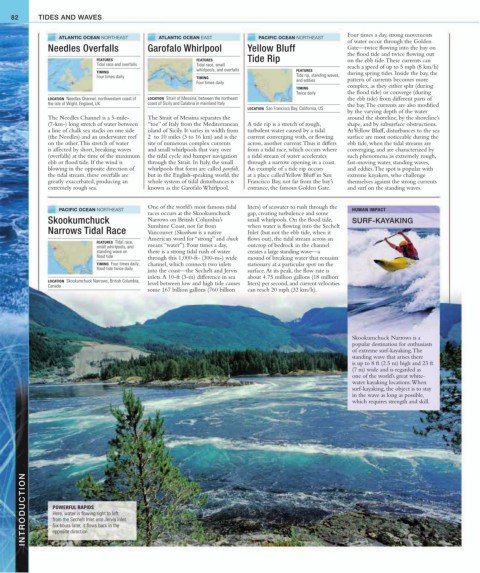
        INTRODUCTION  POWERFUL RAPIDS


                 Here, water is flowing right to left,
                 from the Sechelt Inlet into Jervis Inlet.
                 Six hours later, it flows back in the
                 opposite direction.

