


Page 79 - (DK) Ocean - The Definitive Visual Guide
P. 79
77


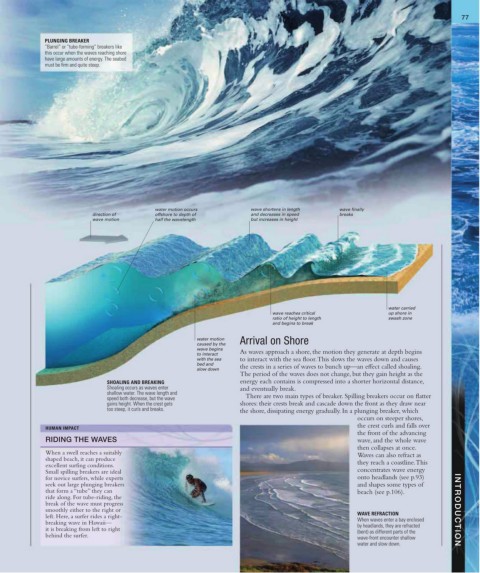
              PLUNGING BREAKER
              “Barrel” or “tube-forming” breakers like
              this occur when the waves reaching shore
              have large amounts of energy. The seabed
              must be firm and quite steep.


                                               water motion occurs          wave shortens in length   wave finally
                            direction of       offshore to depth of         and decreases in speed    breaks
                            wave motion        half the wavelength          but increases in height


                                                                                                                     water carried
                                                                                  wave reaches critical              up shore in
                                                                                  ratio of height to length          swash zone
                                                                                  and begins to break

                                                            water motion   Arrival on Shore
                                                            caused by the
                                                            wave begins
                                                            to interact    As waves approach a shore, the motion they generate at depth begins
                                                            with the sea    to interact with the sea floor. This slows the waves down and causes
                                                            bed and
                                                            slow down   the crests in a series of waves to bunch up—an effect called shoaling.
                                                                        The period of the waves does not change, but they gain height as the
                                 SHOALING AND BREAKING                  energy each contains is compressed into a shorter horizontal distance,
                                 Shoaling occurs as waves enter         and eventually break.
                                 shallow water. The wave length and
                                 speed both decrease, but the wave        There are two main types of breaker. Spilling breakers occur on flatter
                                 gains height. When the crest gets      shores: their crests break and cascade down the front as they draw near
                                 too steep, it curls and breaks.        the shore, dissipating energy gradually. In a plunging breaker, which
                                                                                                           occurs on steeper shores,
                                                                                                           the crest curls and falls over
              HUMAN IMPACT
                                                                                                           the front of the advancing
              RIDING THE WAVES                                                                             wave, and the whole wave
                                                                                                           then collapses at once.
              When a swell reaches a suitably                                                              Waves can also refract as
              shaped beach, it can produce
              excellent surfing conditions.                                                                they reach a coastline. This
              Small spilling breakers are ideal                                                            concentrates wave energy
              for novice surfers, while experts                                                            onto headlands (see p.93)
              seek out large plunging breakers                                                             and shapes some types of
              that form a “tube” they can                                                                  beach (see p.106).
              ride along. For tube-riding, the
              break of the wave must progress
              smoothly either to the right or                                                                                            INTRODUCTION
              left. Here, a surfer rides a right-                                                          WAVE REFRACTION
                                                                                                           When waves enter a bay enclosed
              breaking wave in Hawaii—                                                                     by headlands, they are refracted
              it is breaking from left to right                                                            (bent) as different parts of the
              behind the surfer.                                                                           wave-front encounter shallow
                                                                                                           water and slow down.

