


Page 82 - (DK) Ocean - The Definitive Visual Guide
P. 82
80


                                                                                                          HUMAN IMPACT
                                                                                                          SURVIVING THE
                                                                                                          OLD SOW

                                                                                                          The Old Sow has caused about
                                                                                                          a dozen fatalities from drowning
                                                                                                          over the past 200 years. Most of
                                                                                                          these involved mariners who
                                                                                                          strayed too close to the whirlpool
                                                                                                          in small rowboats or sailboats.
                                                                                                          In recent times, a few people in
                                                                                                          powerboats have had anxious
                                                                                                          experiences when their engines
                                                                                                          have stalled. Experienced
                                                                                                          mariners advise that if caught
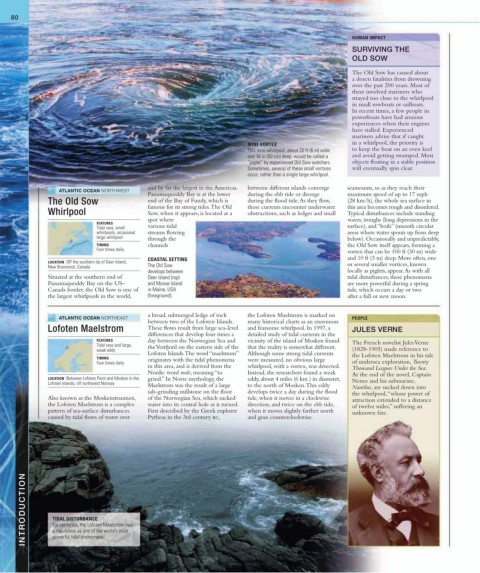
                                                                           MINI-VORTEX                    in a whirlpool, the priority is
                                                                           This mini-whirlpool, about 20 ft (6 m) wide    to keep the boat on an even keel
                                                                           and 16 in (50 cm) deep, would be called a   and avoid getting swamped. Most
                                                                           “piglet” by experienced Old Sow watchers.   objects floating in a stable position
                                                                           Sometimes, several of these small vortices   will eventually spin clear.
                                                                           occur, rather than a single large whirlpool.

                  ATLANTIC OCEAN NORTHWEST   and by far the largest in the Americas.   between different islands converge   seamounts, so as they reach their
                                             Passamaquoddy Bay is at the lower   during the ebb tide or diverge    maximum speed of up to 17 mph
               The Old Sow                   end of the Bay of Fundy, which is   during the flood tide. As they flow,   (28 km/h), the whole sea surface in
                                             famous for its strong tides. The Old   these currents encounter underwater   this area becomes rough and disordered.
               Whirlpool                     Sow, when it appears, is located at a   obstructions, such as ledges and small   Typical disturbances include standing
                                             spot where                                                 waves, troughs (long depressions in the
                              FEATURES
                              Tidal race, small   various tidal                                         surface), and “boils” (smooth circular
                              whirlpools, occasional   streams flowing                                  areas where water spouts up from deep
                              large whirlpool  through the                                              below). Occasionally and unpredictably,
                              TIMING         channels                                                   the Old Sow itself appears, forming a
                              Four times daily
                                                                                                        vortex that can be 100 ft (30 m) wide
                                             COASTAL SETTING                                            and 10 ft (3 m) deep. More often, one
               LOCATION  Off the southern tip of Deer Island,                                           or several smaller vortices, known
               New Brunswick, Canada         The Old Sow
                                             develops between                                           locally as piglets, appear. As with all
               Situated at the southern end of  Deer Island (top)                                       tidal disturbances, these phenomena
               Passamaquoddy Bay on the US–  and Moose Island                                           are more powerful during a spring
               Canada border, the Old Sow is one of   in Maine, USA                                     tide, which occurs a day or two
               the largest whirlpools in the world,   (foreground).                                     after a full or new moon.


                  ATLANTIC OCEAN NORTHEAST   a broad, submerged ledge of rock   the Lofoten Maelstrom is marked on   PEOPLE
                                             between two of the Lofoten Islands.   many historical charts as an enormous
               Lofoten Maelstrom             These flows result from large sea-level   and fearsome whirlpool. In 1997, a   JULES VERNE
                                             differences that develop four times a   detailed study of tidal currents in the
                              FEATURES       day between the Norwegian Sea and   vicinity of the island of Mosken found
                              Tidal race and large,   the Vestfjord on the eastern side of the   that the reality is somewhat different.   The French novelist Jules Verne
                              weak eddy                                                                   (1828-1905) made reference to
                                             Lofoten Islands. The word “maelstrom”   Although some strong tidal currents
                              TIMING         originates with the tidal phenomena   were measured, no obvious large   the Lofoten Maelstrom in his tale
                              Four times daily                                                            of undersea exploration, Twenty
                                             in this area, and is derived from the   whirlpool, with a vortex, was detected.   Thousand Leagues Under the Sea.
                                             Nordic word male, meaning “to   Instead, the researchers found a weak   At the end of the novel, Captain
               LOCATION  Between Lofoten Point and Mosken in the   grind.” In Norse mythology, the   eddy, about 4 miles (6 km ) in diameter,
               Lofoten Islands, off northwest Norway  Maelstrom was the result of a large   to the north of Mosken. This eddy   Nemo and his submarine,
                                                                                                          Nautilus, are sucked down into
                                             salt-grinding millstone on the floor    develops twice a day during the flood   the whirlpool, “whose power of
               Also known as the Moskenstraumen,   of the Norwegian Sea, which sucked   tide, when it moves in a clockwise   attraction extended to a distance
               the Lofoten Maelstrom is a complex   water into its central hole as it turned.   direction, and twice on the ebb tide,   of twelve miles,” suffering an
               pattern of sea-surface disturbances   First described by the Greek explorer   when it moves slightly farther north   unknown fate.
               caused by tidal flows of water over    Pytheas in the 3rd century bc,    and goes counterclockwise.


        INTRODUCTION  TIDAL DISTURBANCE


                 For centuries, the Lofoten Maelstrom had
                 a reputation as one of the world’s most
                 powerful tidal phenomena.

