


Page 81 - (DK) Ocean - The Definitive Visual Guide
P. 81
TIDES       79
                     Sun
                                   Monthly Cycle                        Tidal Currents
                           SPRING
               new Moon    TIDES
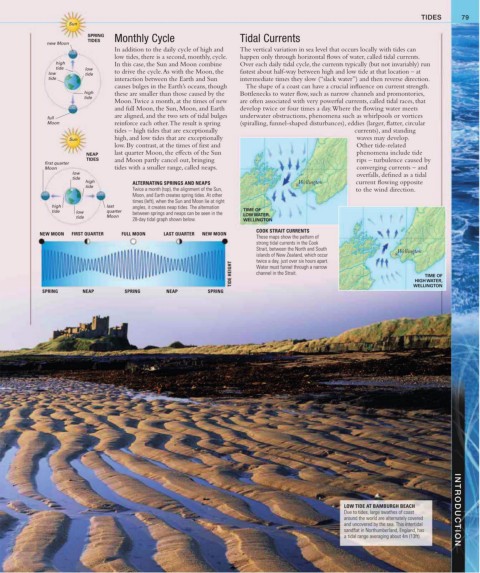
                                   In addition to the daily cycle of high and   The vertical variation in sea level that occurs locally with tides can
                                   low tides, there is a second, monthly, cycle.   happen only through horizontal flows of water, called tidal currents.
                 high              In this case, the Sun and Moon combine    Over each daily tidal cycle, the currents typically (but not invariably) run
                 tide     low
               low        tide     to drive the cycle. As with the Moon, the   fastest about half-way between high and low tide at that location – at
               tide                interaction between the Earth and Sun   intermediate times they slow (“slack water”) and then reverse direction.
                                   causes bulges in the Earth’s oceans, though   The shape of a coast can have a crucial influence on current strength.
                          high     these are smaller than those caused by the   Bottlenecks to water flow, such as narrow channels and promontories,
                          tide
                                   Moon. Twice a month, at the times of new   are often associated with very powerful currents, called tidal races, that
                                   and full Moon, the Sun, Moon, and Earth   develop twice or four times a day. Where the flowing water meets
                                   are aligned, and the two sets of tidal bulges   underwater obstructions, phenomena such as whirlpools or vortices
               full
               Moon                reinforce each other. The result is spring   (spiralling, funnel-shaped disturbances), eddies (larger, flatter, circular
                                   tides – high tides that are exceptionally                               currents), and standing
                                   high, and low tides that are exceptionally                              waves may develop.
                     Sun
                                   low. By contrast, at the times of first and                             Other tide-related
                                   last quarter Moon, the effects of the Sun                               phenomena include tide
                           NEAP
                                   and Moon partly cancel out, bringing                                    rips – turbulence caused by
                           TIDES
              first quarter
              Moon                 tides with a smaller range, called neaps.                               converging currents – and
                      low                                                                                  overfalls, defined as a tidal
                      tide
                          high          ALTERNATING SPRINGS AND NEAPS                     Wellington       current flowing opposite
                          tide
                                        Twice a month (top), the alignment of the Sun,                     to the wind direction.
                                        Moon, and Earth creates spring tides. At other
                                        times (left), when the Sun and Moon lie at right
                high             last   angles, it creates neap tides. The alternation
                tide    low      quarter   between springs and neaps can be seen in the   TIME OF
                        tide     Moon                                    LOW WATER,
                                        28-day tidal graph shown below.  WELLINGTON
                                                                             COOK STRAIT CURRENTS
             NEW MOON  FIRST QUARTER  FULL MOON   LAST QUARTER  NEW MOON
                                                                             These maps show the pattern of
                                                                             strong tidal currents in the Cook
                                                                             Strait, between the North and South       Wellington
                                                                             islands of New Zealand, which occur
                                                                             twice a day, just over six hours apart.
                                                                      TIDE HEIGHT  channel in the Strait.                       TIME OF
                                                                             Water must funnel through a narrow
                                                                                                                             HIGH WATER,
                                                                                                                            WELLINGTON
             SPRING       NEAP        SPRING      NEAP         SPRING


                                                                                                       LOW TIDE AT BAMBURGH BEACH
                                                                                                       Due to tides, large swathes of coast   INTRODUCTION
                                                                                                       around the world are alternately covered
                                                                                                       and uncovered by the sea. This intertidal
                                                                                                       sandflat in Northumberland, England, has
                                                                                                       a tidal range averaging about 4m (13ft).

