


Page 80 - (DK) Ocean - The Definitive Visual Guide
P. 80
78      WAVES AND TIDES

                                                                                                                            Time (hrs)
                                                                                                                       0         6        12        18       24
               Tides                                                       If no continents existed and the Moon    3m/10ft
                                                                           Tidal Patterns
                                                                           orbited in the Earth’s equatorial plane, the   2m/6ft          Tide heights
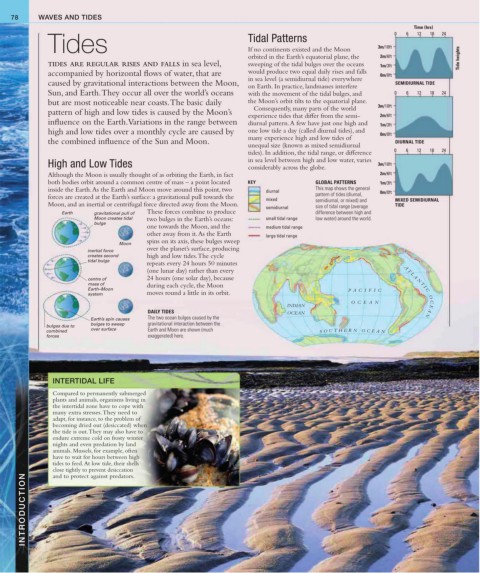
               TIDES ARE REGULAR RISES AND FALLS in sea level,             sweeping of the tidal bulges over the oceans   1m/3ft
               accompanied by horizontal flows of water, that are          would produce two equal daily rises and falls   0m/0ft
                                                                           in sea level (a semidiurnal tide) everywhere
               caused by gravitational interactions between the Moon,                                                  SEMIDIURNAL TIDE
                                                                           on Earth. In practice, landmasses interfere
               Sun, and Earth. They occur all over the world’s oceans      with the movement of the tidal bulges, and    0         6        12        18       24
               but are most noticeable near coasts. The basic daily        the Moon’s orbit tilts to the equatorial plane.
                                                                             Consequently, many parts of the world   3m/10ft
               pattern of high and low tides is caused by the Moon’s
                                                                           experience tides that differ from the semi-   2m/6ft
               influence on the Earth. Variations in the range between     diurnal pattern. A few have just one high and   1m/3ft
               high and low tides over a monthly cycle are caused by       one low tide a day (called diurnal tides), and   0m/0ft
                                                                           many experience high and low tides of
               the combined influence of the Sun and Moon.                                                             DIURNAL TIDE
                                                                           unequal size (known as mixed semidiurnal
                                                                           tides). In addition, the tidal range, or difference   0         6        12        18         24
               High and Low Tides                                          in sea level between high and low water, varies   3m/10ft
                                                                           considerably across the globe.
               Although the Moon is usually thought of as orbiting the Earth, in fact                             2m/6ft
               both bodies orbit around a common centre of mass – a point located   KEY        GLOBAL PATTERNS    1m/3ft
               inside the Earth. As the Earth and Moon move around this point, two   diurnal   This map shows the general   0m/0ft
               forces are created at the Earth’s surface: a gravitational pull towards the     pattern of tides (diurnal,
                                                                                mixed          semidiurnal, or mixed) and    MIXED SEMIDIURNAL
               Moon, and an inertial or centrifugal force directed away from the Moon.                                 TIDE
                                                                                semidiurnal    size of tidal range (average
                   Earth     gravitational pull of   These forces combine to produce           difference between high and
                             Moon creates tidal   two bulges in the Earth’s oceans:   small tidal range   low water) around the world.
                             bulge
                                             one towards the Moon, and the      medium tidal range
                                             other away from it. As the Earth   large tidal range
                                             spins on its axis, these bulges sweep
                                    Moon
                                             over the planet’s surface, producing
                           inertial force
                           creates second    high and low tides. The cycle
                           tidal bulge
                                             repeats every 24 hours 50 minutes
                                             (one lunar day) rather than every
                           centre of         24 hours (one solar day), because
                           mass of           during each cycle, the Moon
                           Earth–Moon                                                                    P A CIFIC
                           system            moves round a little in its orbit.                                           A T L A N T I C   O C E A N
                                                                                                          OCEAN
                                                                                      INDIAN
                                             DAILY TIDES                              OCEAN
                            Earth’s spin causes   The two ocean bulges caused by the
                            bulges to sweep   gravitational interaction between the
               bulges due to
               combined     over surface     Earth and Moon are shown (much                     S O U T H E R N   O C E A N
               forces                        exaggerated) here.


                 INTERTIDAL LIFE

                 Compared to permanently submerged
                 plants and animals, organisms living in
                 the intertidal zone have to cope with
                 many extra stresses. They need to
                 adapt, for instance, to the problem of
                 becoming dried out (desiccated) when
                 the tide is out. They may also have to
                 endure extreme cold on frosty winter
                 nights and even predation by land
                 animals. Mussels, for example, often
                 have to wait for hours between high
                 tides to feed. At low tide, their shells
                 close tightly to prevent desiccation
        INTRODUCTION
                 and to protect against predators.

