


Page 83 - (DK) Ocean - The Definitive Visual Guide
P. 83
81


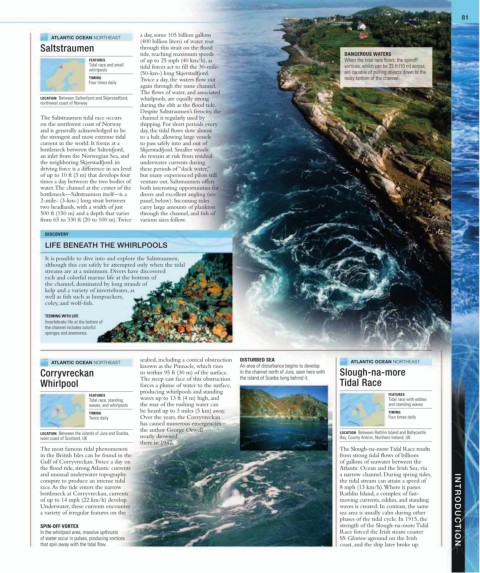
                ATLANTIC OCEAN NORTHEAST   a day, some 105 billion gallons
                                           (400 billion liters) of water roar
             Saltstraumen                  through this strait on the flood
                                           tide, reaching maximum speeds                                DANGEROUS WATERS
                           FEATURES        of up to 25 mph (40 km/h), as                                When the tidal race flows, the spinoff
                           Tidal race and small   tidal forces act to fill the 30-mile-                 vortices, which can be 33 ft (10 m) across,
                           whirlpools
                                           (50-km-) long Skjerstadfjord.                                are capable of pulling objects down to the
                           TIMING          Twice a day, the waters flow out                             rocky bottom of the channel.
                           Four times daily
                                           again through the same channel.
                                           The flows of water, and associated
             LOCATION  Between Saltenfjord and Skjerstadfjord,   whirlpools, are equally strong
             northwest coast of Norway
                                           during the ebb as the flood tide.
                                           Despite Saltstraumen’s ferocity, the
             The Saltstraumen tidal race occurs    channel is regularly used by
             on the northwest coast of Norway    shipping. For short periods every
             and is generally acknowledged to be   day, the tidal flows slow almost
             the strongest and most extreme tidal   to a halt, allowing large vessels
             current in the world. It forms at a   to pass safely into and out of
             bottleneck between the Saltenfjord,    Skjerstadfjord. Smaller vessels
             an inlet from the Norwegian Sea, and   do remain at risk from residual
             the neighboring Skjerstadfjord: its   underwater currents during
             driving force is a difference in sea level   these periods of “slack water,”
             of up to 10 ft (3 m) that develops four   but many experienced pilots still
             times a day between the two bodies of   venture out. Saltstraumen offers
             water. The channel at the center of the   both interesting opportunities for
             bottleneck—Saltstraumen itself—is a   divers and excellent angling (see
             2-mile- (3-km-) long strait between   panel, below). Incoming tides
             two headlands, with a width of just   carry large amounts of plankton
             500 ft (150 m) and a depth that varies   through the channel, and fish of
             from 65 to 330 ft (20 to 100 m). Twice   various sizes follow.

              DISCOVERY
              LIFE BENEATH THE WHIRLPOOLS

              It is possible to dive into and explore the Saltstraumen,
              although this can safely be attempted only when the tidal
              streams are at a minimum. Divers have discovered
              rich and colorful marine life at the bottom of
              the channel, dominated by long strands of
              kelp and a variety of invertebrates, as
              well as fish such as lumpsuckers,
              coley, and wolf-fish.
              TEEMING WITH LIFE
              Invertebrate life at the bottom of
              the channel includes colorful
              sponges and anemones.


                                           seabed, including a conical obstruction   DISTURBED SEA
                ATLANTIC OCEAN NORTHEAST                                                                 ATLANTIC OCEAN NORTHEAST
                                           known as the Pinnacle, which rises    An area of disturbance begins to develop
             Corryvreckan                  to within 95 ft (30 m) of the surface.    in the channel north of Jura, seen here with   Slough-na-more
                                           The steep east face of this obstruction   the island of Scarba lying behind it.
             Whirlpool                     forces a plume of water to the surface,                    Tidal Race
                                           producing whirlpools and standing
                           FEATURES                                                                                  FEATURES
                           Tidal race, standing   waves up to 13 ft (4 m) high, and                                  Tidal race with eddies
                           waves, and whirlpools  the roar of the rushing water can                                  and standing waves
                                           be heard up to 3 miles (5 km) away.
                           TIMING                                                                                    TIMING
                           Twice daily     Over the years, the Corryvreckan                                          Four times daily
                                           has caused numerous emergencies –
                                           the author George Orwell
             LOCATION  Between the islands of Jura and Scarba,                                        LOCATION  Between Rathlin Island and Ballycastle
             west coast of Scotland, UK    nearly drowned                                             Bay, County Antrim, Northern Ireland, UK
                                           there in 1947.
             The most famous tidal phenomenon                                                         The Slough-na-more Tidal Race results
             in the British Isles can be found in the                                                 from strong tidal flows of billions
             Gulf of Corryvreckan. Twice a day on                                                     of gallons of seawater between the
             the flood tide, strong Atlantic currents                                                 Atlantic Ocean and the Irish Sea, via
             and unusual underwater topography                                                        a narrow channel. During spring tides,
             conspire to produce an intense tidal                                                     the tidal stream can attain a speed of
             race. As the tide enters the narrow                                                      8 mph (13 km/h). Where it passes
             bottleneck at Corryvreckan, currents                                                     Rathlin Island, a complex of fast-
             of up to 14 mph (22 km/h) develop.                                                       moving currents, eddies, and standing
             Underwater, these currents encounter                                                     waves is created. In contrast, the same
             a variety of irregular features on the                                                   sea area is usually calm during other   INTRODUCTION
                                                                                                      phases of the tidal cycle. In 1915, the
             SPIN-OFF VORTEX                                                                          strength of the Slough-na-more Tidal
             In the whirlpool area, massive upthrusts                                                 Race forced the Irish steam coaster
             of water occur in pulses, producing vortices                                             SS Glentow aground on the Irish
             that spin away with the tidal flow.                                                       coast, and the ship later broke up.

