


Page 32 - (DK Eyewitness) Travel Guide - Krakow
P. 32
30 INTRODUCING KR AK OW
Baroque Krakow
The 17th and 18th centuries saw the decline of Krakow.
After the king had moved his residence to Warsaw, he was
followed by the noblemen who held high office. Foreign
incursions and occupations, wars and the First Partition
of Poland in 1772 all added to the city’s woes. Despite a
number of attempts at reform towards the end of the rule
of Stanisław August Poniatowski, Krakow became a provincial, Extent of the City
underdeveloped frontier town, though the atmosphere was 1700 Today
enlivened by royal coronations and funerals. The failure of
the Kościuszko Insurrection of 1794 and the subsequent
Third Partition of Poland in 1795 brought an end to
Krakow’s prominence.
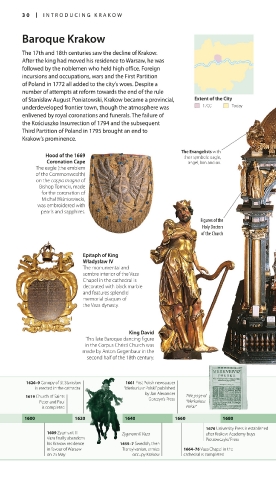
The Evangelists with
Hood of the 1669 their symbols: eagle,
Coronation Cape angel, lion and ox.
The eagle (the emblem
of the Commonwealth)
on the cappa magna of
Bishop Tomicki, made
for the coronation of
Michał Wiśniowiecki,
was embroidered with
pearls and sapphires.
Figures of the
Holy Doctors
of the Church
Epitaph of King
Władysław IV
The monumental and
sombre interior of the Vaza
Chapel in the cathedral is
decorated with black marble
and features splendid
memorial plaques of
the Vaza dynasty.
King David
This late Baroque dancing figure
in the Corpus Christi Church was
made by Anton Gegenbaur in the
second half of the 18th century.
1626–9 Canopy of St Stanisław 1661 First Polish newspaper
is erected in the cathedral “Merkuriusz Polski” published
by Jan Alexander
1619 Church of Saints Gorczyn’s Press Title page of
Peter and Paul “Merkuriusz
is completed Polski”
1600 1620 1640 1660 1680
1676 University Press is established
1609 Zygmunt III Zygmunt III Vaza after Krakow Academy buys
Vaza finally abandons Piotrowczyks’ Press
his Krakow residence 1655–7 Swedish, then
in favour of Warsaw Transylvanian, armies 1664–76 Vaza Chapel in the
on 25 May occupy Krakow cathedral is completed

