


Page 34 - (DK Eyewitness) Travel Guide - Krakow
P. 34
32 INTRODUCING KR AK OW
Krakow in Galicia
In 1772 Austria occupied the southern part of Poland, called
Galicia. After a period of Austrian occupation, Krakow was briefly
incorporated into the Duchy of Warsaw. The Russian occupation
followed. In 1815 the Republic of Krakow, which included the
area round the city, was established, but by 1846 Krakow was
under Austrian rule again. After a period of suppression, Galicia
received extensive autonomy from the 1860s onwards. During Extent of the City
the 19th century Krakow was the only Polish territory to enjoy 1818 Today
relative freedom. It embarked upon a mission of safeguarding
traditions and celebrating past historic successes, thus becoming
the spiritual capital of Poland.
A beggar woman Emperor
receiving alms Franz Joseph
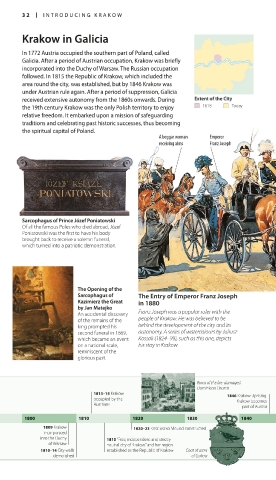
Sarcophagus of Prince Józef Poniatowski
Of all the famous Poles who died abroad, Józef
Poniatowski was the first to have his body
brought back to receive a solemn funeral,
which turned into a patriotic demonstration.
The Opening of the
Sarcophagus of The Entry of Emperor Franz Joseph
Kazimierz the Great in 1880
by Jan Matejko
An accidental discovery Franz Joseph was a popular ruler with the
of the remains of the people of Krakow. He was believed to be
king prompted his behind the development of the city and its
second funeral in 1869, autonomy. A series of watercolours by Juliusz
which became an event Kossak (1824–99), such as this one, depicts
on a national scale, his stay in Krakow.
reminiscent of the
glorious past.
Ruins of the fire-damaged
Dominican Church
1813–15 Krakow 1846 Krakow Uprising.
occupied by the Krakow becomes
Austrians
part of Austria
1800 1810 1820 1830 1840
1809 Krakow 1820–23 Kościuszko Mound constructed
incorporated
into the Duchy 1815 “Free, independent and strictly
of Warsaw neutral city of Krakow” and her region
1810–14 City walls established as the Republic of Krakow Coat of arms
demolished of Galicia

