


Page 67 - Mother & Baby - UK (March 2020)
P. 67
Baby&Toddler
with others grow too. ‘One of the clearest
milestones comes at between seven and nine
months, when babies tend to begin exhibiting
a clear preference for particular care givers,’
tip
says Pasco. ‘Your baby might go from being
From the age of one, happily passed around extended family
when you’re playing with members, to wanting to be carried by mum,
your baby, clearly look at and mum alone. It may feel like grandma
an object before picking it up. is suddenly being given the cold shoulder,
This will help your little one but this is a positive sign that your baby is
realise that you are thinking, actively choosing an attachment.’ So rather
and grasp your thought
processes. than seeing what we know as ‘separation
anxiety’ as a problem, we should be seeing
it as evidence of a great bond between mum
and baby: he’s simply expressing his view that
he’d rather be with you!
But don’t think that this means you should
be the sole person caring for your baby.
Research suggests that young children benefit
significantly from strong relationships with a
wider circle of people, as long as their primary
attachment bond – the one with you – is
secure. ‘And that means that your child feels
he has someone he can go and feel safe with
when he is frightened or distressed,’ says
Pasco. ‘In a child’s first three years, his social
world is expanding enormously, but it is
supported by having a strong bond to fall
back on when necessary.’
Your little one becomes increasingly
sophisticated at this relationship business.
‘We now know that toddlers begin to build
the basic ability to grasp what might be going
on in other people’s minds from the age of
about one or even younger,’ says Pasco.
Studies show that somewhere around the age
of 12 months, youngsters typically begin
to follow the gaze of people around
them. Try it for yourself: if you
look at a ball, say, your baby will
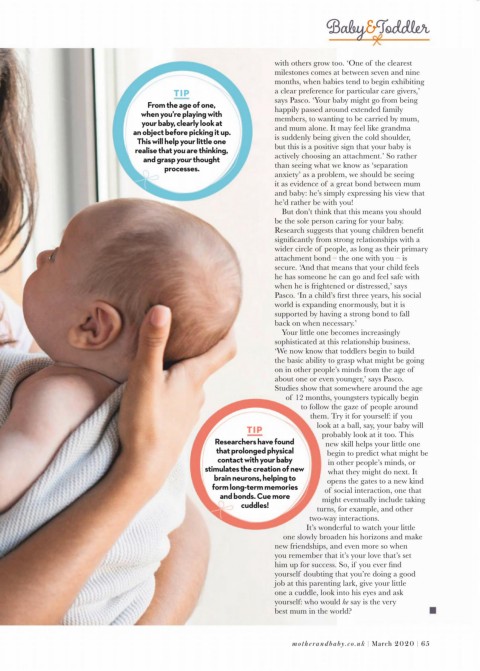
tip
probably look at it too. This
Researchers have found new skill helps your little one
that prolonged physical begin to predict what might be
contact with your baby in other people’s minds, or
stimulates the creation of new what they might do next. It
brain neurons, helping to opens the gates to a new kind
form long-term memories of social interaction, one that
and bonds. Cue more might eventually include taking
cuddles! turns, for example, and other
two-way interactions.
It’s wonderful to watch your little
one slowly broaden his horizons and make
new friendships, and even more so when
you remember that it’s your love that’s set
him up for success. So, if you ever find
yourself doubting that you’re doing a good
job at this parenting lark, give your little
one a cuddle, look into his eyes and ask
yourself: who would he say is the very
best mum in the world?
mothe ra ndbaby.co.uk | March 2 0 2 0 | 6 5

