


Page 27 - Flight International (January 2020)
P. 27
COVER STORY


        Progress in


        revolutions
        Now nearing the end of its development cycle, the H160
        may appear like just another rotorcraft, but manufacturer
        Airbus Helicopters promises a step-change in performance


                                             outside at least, the H160 appears to be more
        DOMINIC PERRY MARSEILLE
                                             evolution than revolution. There are distinc-
              or Airbus Helicopters, the end of the   tive tweaks, such as the hockey-stick-shaped
              long road to certification for the H160   main rotor blades, canted Fenestron and “bi-
              now appears to be in sight. Launched   plane” horizontal stabiliser, but it still appears
       Fin 2015, the medium-twin is in the   much as you would expect a helicopter to.
        final stages of its development campaign; test   Its engines do offer a step change in
        flights ended in late 2019 and, at the time of   performance, however: Safran Helicopter
        writing in mid-January, Airbus Helicopters   Engines promises that its 1,280shp (955kW)
        was preparing to submit the final pieces of   Arrano 1A turboshaft will offer a specific fuel
        documentation to the European Union Avia-  consumption improvement of 10-15% over
        tion Safety Agency.                  previous-generation powerplants.
          Deliveries are due to begin in the second
        half of 2020 – about two years later than ini-  NEW PRIORITIES
        tially planned – with the first aircraft to be   But the real differences are under the skin.
        handed to an unnamed US customer.    As you might expect from a test pilot, Gensse
          Experimental test pilot Olivier Gensse has   waxes lyrical about the H160’s handling –
        been involved in the programme since its   something he later shows off during a
        very beginning: during a media event to   40min demonstration flight – but also points
        launch the H160 in 2015 he “flew” journalists   to the enhanced levels of comfort the
        on the airframer’s system helicopter zero,     helicopter offers.        we could and then said to customers that they
        a simulation device intended to ensure early   He says that the H160 marked a departure   could put whatever they liked in the back.”
        maturation of the aircraft.          for Airbus Helicopters in that it was the first   This time, customer perspective has been
          As you might expect, Gensse is immensely   aircraft it developed with customer priorities   front and centre. Gensse likens it to the auto-
        proud of the 6t-class H160, believing it to offer   at the heart of the effort.   motive industry – where two cars can be pro-
        a step change in performance over the previ-  “Until the new generation, we focused on   duced to the same safety standards but, for
        ous generation of helicopters. But from the   the vehicle and tried to build the best aircraft   some reason, one feels better than the other.
                                                                                 “What you could sell in a car 40 years ago
                                                                                 you can’t sell today – and that’s the same with
                                                                                 helicopters,” he says.
                                                                                   Improved passenger comfort has been
                                                                                 driven by work across “four axes”, says
                                                                                 Gensse: vibration, noise, visibility and
                                                                                 climate control.
                                                                                   Low levels of vibration and noise have
                                                                                 been achieved without a need for add-on sys-
                                                                                 tems, delivering what Gensse calls “a  new
                                                                                 standard”. Improvements can be traced to fea-
                                                                                 tures including the new main rotor blades
                                                                                 and Fenestron, but also the general stability of
                                                                                 the H160. In addition, the fact that no extra
                                                                                 vibration damping system is required saves
                                                                                 40-50kg (88-110lb) in unneeded equipment.
                                                                                Airbus Helicopters  or cooling system as soon as the engines
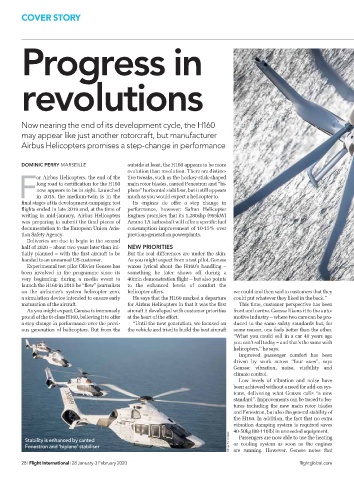
          Stability is enhanced by canted                                          Passengers are now able to use the heating
          Fenestron and 'biplane' stabiliser                                     are  running. However, Gensse notes that


        28  |  Flight International  |  28 January-3 February 2020                                      flightglobal.com

