


Page 29 - Flight International (January 2020)
P. 29
ROTORCRAFT


        GARRETT REIM AMARILLO
              ack in January 2019, when Bell first
              unveiled its Nexus electric vertical
              take-off and landing (eVTOL) aircraft,   Vertical
       Bthe design featured six ducted fans
        and was to be powered by a hybrid-electric
        architecture. But fast forward 12 months and
        the aircraft has undergone a major revamp:
        two ducted fans have been removed, all-
        electric propulsion is now planned and the   challenge
        wing has been lengthened.
          The new demonstrator, revealed at this
        year’s Consumer Electronics Show in Las   Strong demand for short-hop intra-city travel has prompted
        Vegas, is called the Nexus 4EX – as in
          “Electric” and “Xperimental”.      Bell to switch its Nexus eVTOL to all-electric power, with
          Removal of the two ducted fans will create
        an aircraft with less drag that is therefore   potential applications in ride sharing and public transport
        more efficient in the cruise, says Bell.
          Efficiency is critically important as battery
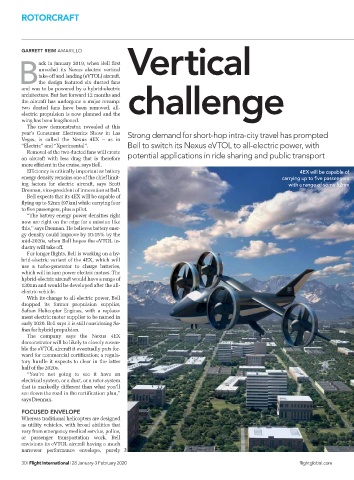
                                                                                                        4EX will be capable of
        energy density remains one of the chief limit-
                                                                                                  carrying up to five passengers
        ing factors for electric aircraft, says Scott
                                                                                                    with a range of some 52nm
        Drennan, vice-president of innovation at Bell.
          Bell expects that its 4EX will be capable of
        flying up to 52nm (97km) while carrying four
        to five passengers, plus a pilot.
          “The battery energy power densities right
        now are right on the edge for a mission like
        this,” says Drennan. He believes battery ener-
        gy density could improve by 10-15% by the
        mid-2020s, when Bell hopes the eVTOL in-
        dustry will take off.
          For longer flights, Bell is working on a hy-
        brid-electric variant of the 4EX, which will
        use a turbo-generator to charge batteries,
        which will in turn power electric motors. The
        hybrid-electric aircraft would have a range of
        130nm and would be developed after the all-
        electric vehicle.
          With its change to all-electric power, Bell
        dropped its former propulsion supplier,
          Safran Helicopter Engines, with a replace-
        ment electric motor supplier to be named in
        early 2020. Bell says it is still considering Sa-
        fran for hybrid propulsion.
          The company says the Nexus 4EX
          demonstrator will be likely to closely resem-
        ble the eVTOL aircraft it eventually puts for-
        ward for commercial certification; a regula-
        tory hurdle it expects to clear in the latter
        half of the 2020s.
          “You’re not going to see it have an
          electrical system, or a duct, or a rotor system
        that is markedly different than what you’ll
        see down the road in the certification plan,”
        says Drennan.


        FOCUSED ENVELOPE
        Whereas traditional helicopters are designed
        as utility vehicles, with broad abilities that
        vary from emergency medical service, police,
        or passenger transportation work, Bell
          envisions its eVTOL aircraft having a much
        narrower performance envelope, purely   Bell


        30  |  Flight International  |  28 January-3 February 2020                                      flightglobal.com

