


Page 32 - Amphibian
P. 32
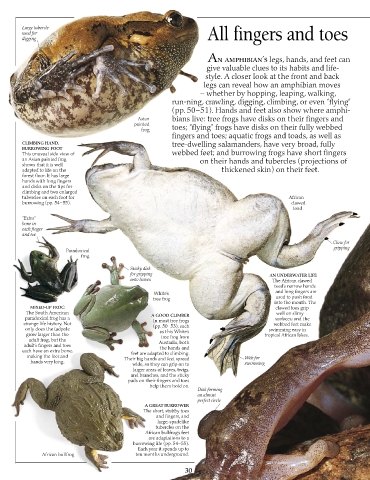
Large tubercle
        used for                                                      All fingers and toes
        digging


                                                                      An amphibian’s legs, hands, and feet can
                                                                     give valuable clues to its habits and life-
                                                                     style. A closer look at the front and back
                                                                    legs can reveal how an amphibian moves
                                                                   – whether by hopping, leaping, walking,
                                                          run-ning, crawling, digging, climbing, or even “flying”
                                                          (pp. 50–51). Hands and feet also show where amphi-
                                               Asian      bians live: tree frogs have disks on their fingers and
                                             painted      toes; “flying” frogs have disks on their fully webbed
                                                frog
                                                          fingers and toes; aquatic frogs and toads, as well as
        CLIMBING HAND,                                    tree-dwelling salamanders, have very broad, fully
        BURROWING FOOT
        This unusual side view of                         webbed feet; and burrowing frogs have short fingers
        an Asian painted frog                                      on their hands and tubercles (projections of
        shows that it is well
        adapted to life on the                                            thickened skin) on their feet.
        forest floor. It has large
        hands with long fingers
        and disks on the tips for
        climbing and two enlarged
        tubercles on each foot for                                                               African
        burrowing (pp. 54–55).                                                                   clawed
                                                                                                  toad
        “Extra”
        bone in
        each finger
        and toe
                                                                                                               Claw for
                                                                                                               gripping
                       Paradoxical
                            frog
                                            Sticky disk
                                            for gripping                                  AN UNDERWATER LIFE
                                            onto leaves                                    The African clawed
                                                                                            toad’s narrow hands
                                                    White’s                                 and long fingers are
                                                    tree frog                               used to push food
                                                                                            into the mouth. The
           MIXED-UP FROG                                                                    clawed toes grip
          The South American                                                                well on slimy
         paradoxical frog has a                    A GOOD CLIMBER                           surfaces; and the
                                                    In most tree frogs
         strange life history. Not                  (pp. 50–53), such                       webbed feet make
         only does the tadpole                        as this White’s                     swimming easy in
          grow larger than the                        tree frog from                     tropical African lakes.
           adult frog, but the                        Australia, both
         adult’s fingers and toes                     the hands and
        each have an extra bone,            feet are adapted to climbing.
          making the feet and             Their big hands and feet spread         Web for
           hands very long.                  wide, so they can grip on to         swimming
                                             larger areas of leaves, twigs,
                                            and branches, and the sticky
                                           pads on their fingers and toes
                                                   help them hold on.
                                                                  Disk forming
                                                                  an almost
                                                                  perfect circle
                                                 A GREAT BURROWER
                                                 The short, stubby toes
                                                     and fingers, and
                                                     large, spadelike
                                                     tubercles on the
                                                 African bullfrog’s feet
                                                  are adaptations to a
                                             burrowing life (pp. 54–55).
                                               Each year it spends up to
               African bullfrog               ten months underground.

                                                              30

