


Page 27 - Amphibian
P. 27
Eye closed
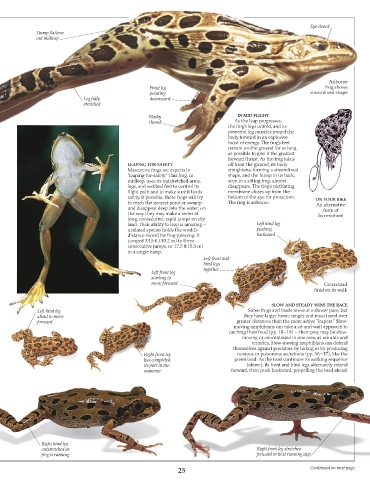
             Hump flattens
             out midleap


                                                                                                              Airborne
                                                   Front leg                                                 frog shows
                                                   pointing                                             streamlined shape
                             Leg fully             downward
                             stretched

                                                  Fleshy                        IN MID-FLIGHT
                                                  thumb                        As the leap progresses,
                                                                             the frog’s legs unfold, and its
                                                                             powerful leg muscles propel the
                                                                             body forward in an explosive
                                                                             burst of energy. The frog’s feet
                                                                             remain on the ground for as long
                                                                             as possible to give it the greatest
                                                                             forward thrust. As the frog takes
                                           LEAPING FOR SAFETY                off from the ground, its body
                                           Mascarene frogs are experts in    straightens, forming a streamlined
                                           “leaping-for-safety.” This frog, in   shape, and the hump in its back,
                                           midleap, uses its outstretched arms,   seen in a sitting frog, almost
                                           legs, and webbed feet to control its   disappears. The frog’s nictitating
                                           flight path and to make sure it lands   membrane closes up from the
                                           safely. If possible, these frogs will try   bottom of the eye for protection.   ON YOUR BIKE
                                           to reach the nearest pond or swamp   The frog is airborne.     An alternative
                                           and disappear deep into the water; on                            form of
                                           the way they may make a series of                              locomotion!
                                           long, consecutive, rapid jumps on dry
                                           land. Their ability to leap is amazing –   Left hind leg
                                           a related species holds the world’s        pushing
                                           distance record for frog-jumping. It       backward
                                           jumped 33.5 ft (10.2 m) in three
                                           consecutive jumps, or 17.5 ft (5.3 m)
                                           in a single jump.
                                                                    Left front and
                                                                    hind legs
                                                                    together
                                                   Left front leg
                                                   starting to
                                                   move forward                                             Green toad
                                                                                                         finishes its walk

                                                                                           SLOW AND STEADY WINS THE RACE
             Left hind leg                                                         Some frogs and toads move at a slower pace, but
             about to move                                                        they have larger home ranges and must travel over
             forward                                                           greater distances than the more active “leapers.” Slow-
                                                                              moving amphibians can take a sit-and-wait approach to
                                                                             catching their food (pp. 18–19) – their prey may be slow-
                                                                                 moving or concentrated in one area, as are ants and
                                                                                    termites. Slow-moving amphibians can defend
                                                                              themselves against predators by hiding or by producing
                                                 Right front leg                noxious or poisonous secretions (pp. 16–17), like the
                                                 has completed                 green toad. As the toad continues its walking sequence
                                                 its part in the                   (above), its front and hind legs alternately extend
                                                 sequence                     forward, then push backward, propelling the toad ahead.


               Right hind leg
               outstretched as                                                        Right front leg stretches
               frog is running                                                        forward in next running step

                                                            25                                          Continued on next page

