


Page 28 - Amphibian
P. 28
Continued from previous page


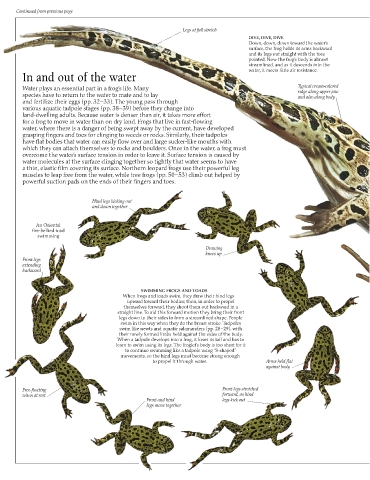
                                                             Legs at full stretch
                                                                                   DIVE, DIVE, DIVE
                                                                                   Down, down, down toward the water’s
                                                                                   surface, the frog holds its arms backward
                                                                                   and its legs out straight with the toes
                                                                                   pointed. Now the frog’s body is almost
                                                                                   streamlined, and as it descends into the
                                                                                   water, it meets little air resistance.
        In and out of the water

        Water plays an essential part in a frog’s life. Many                                        Typical cream-colored
                                                                                                    ridge along upper jaw
        species have to return to the water to mate and to lay                                      and also along body
        and fertilize their eggs (pp. 32–33). The young pass through
        various aquatic tadpole stages (pp. 38–39) before they change into
        land-dwelling adults. Because water is denser than air, it takes more effort
        for a frog to move in water than on dry land. Frogs that live in fast-flowing
        water, where there is a danger of being swept away by the current, have developed
        grasping fingers and toes for clinging to weeds or rocks. Similarly, their tadpoles
        have flat bodies that water can easily flow over and large sucker-like mouths with
        which they can attach themselves to rocks and boulders. Once in the water, a frog must
        overcome the water’s surface tension in order to leave it. Surface tension is caused by
        water molecules at the surface clinging together so tightly that water seems to have
        a thin, elastic film covering its surface. Northern leopard frogs use their powerful leg
        muscles to leap free from the water, while tree frogs (pp. 50–53) climb out helped by
        powerful suction pads on the ends of their fingers and toes.


                                Hind legs kicking out
                                and down together


             An Oriental
            fire-bellied toad
             swimming

                                                                     Drawing
                                                                     knees up
        Front legs
        extending
        backward


                                                SWIMMING FROGS AND TOADS
                                          When frogs and toads swim, they draw their hind legs
                                           upward toward their bodies; then, in order to propel
                                          themselves forward, they shoot them out backward in a
                                        straight line. To aid this forward motion they bring their front
                                        legs down to their sides to form a streamlined shape. People
                                         swim in this way when they do the breast stroke. Tadpoles
                                         swim like newts and aquatic salamanders (pp. 28–29), with
                                        their newly formed limbs held against the sides of the body.
                                        When a tadpole develops into a frog, it loses its tail and has to
                                       learn to swim using its legs. The froglet’s body is too short for it
                                          to continue swimming like a tadpole using “S-shaped”
                                         movements, so the hind legs must become strong enough
                                                    to propel it through water.          Arms held flat
                                                                                         against body


        Free-floating                                                      Front legs stretched
        when at rest                                                       forward, as hind
                                                 Front and hind            legs kick out
                                                 legs move together

