


Page 30 - Amphibian
P. 30
Continued from previous page


                   On all fours                                                                               Tail
                                                                                                              curving
                   Newts and salamanders (pp. 46–49) usually move quite slowly. They                          to left
                   walk or crawl on land, underground, in the trees, or on the bottom of ponds.
                   But they will move quickly to escape danger. Certain species can also swim
                   or burrow: mole and tiger salamanders burrow with their hands and feet, and
                   male aquatic newts perform swimming courtship displays in front of the females
                   (pp. 34–35). Some salamanders live among grasses, on low bushes, and even high up in
                   the trees; they have stubby, webbed feet for gripping leaves. So far, no “flying” salamanders
                     have been found, but some “spring” when startled. Most of the legless caecilians are
                            burrowers, but one group lives in water.


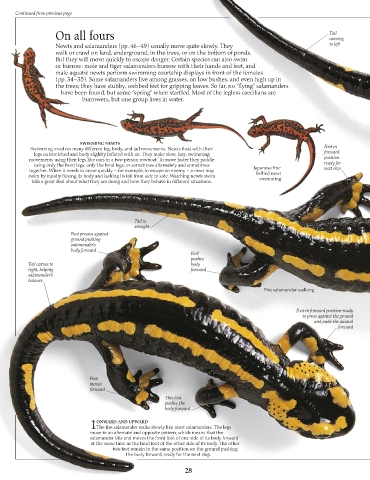
                           SWIMMING NEWTS
           Swimming involves many different leg, body, and tail movements. Newts float with their           Foot in
            legs outstretched and body slightly inflated with air. They make slow, lazy, swimming           forward
           movements using their legs like oars in a two-person rowboat. To move faster they paddle         position
            using only the front legs, only the hind legs, or sometimes alternately and sometimes           ready for
           together. When it needs to move quickly – for example, to escape an enemy – a newt may   Japanese fire-  next step
          swim by rapidly flexing its body and lashing its tail from side to side. Watching newts swim   bellied newt
           tells a great deal about what they are doing and how they behave in different situations.  swimming


                                              Tail is
                                              straight
                         Foot presses against
                         ground pushing
                         salamander’s
                         body forward
                                                                Foot
                                                                pushes
          Tail curves to                                        body
          right, helping                                        forward
          salamander’s
          balance
                                                                                        Fire salamander walking


                                                                                                   Foot in forward position ready
                                                                                                     to press against the ground
                                                                                                         and push the animal
                                                                                                                 forward


                               Foot
                               moves
                               forward
                                                        This foot
                                                        pushes the
                                                        body forward
                                 ONWARD AND UPWARD
                               1The fire salamander walks slowly like most salamanders. The legs
                               move in an alternate and opposite pattern, which means that the
                               salamander lifts and moves the front foot of one side of its body forward
                               at the same time as the hind foot of the other side of its body. The other
                                      two feet remain in the same position on the ground pushing
                                           the body forward, ready for the next step.

                                                              2

