


Page 33 - Amphibian
P. 33
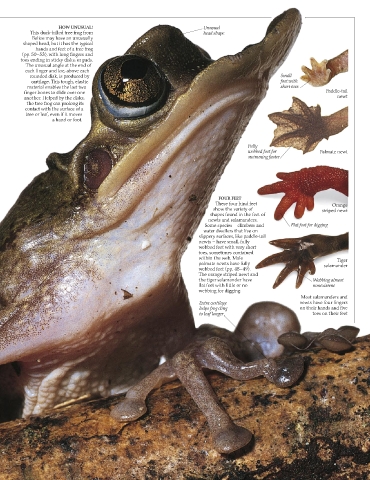
HOW UNUSUAL!                                    Unusual
           This duck-billed tree frog from                          head shape
            Belize may have an unusually
         shaped head, but it has the typical
             hands and feet of a tree frog
        (pp. 50–53), with long fingers and
        toes ending in sticky disks, or pads.
          The unusual angle at the end of
         each finger and toe, above each
           rounded disk, is produced by                                                       Small
           cartilage. This tough, elastic                                                     foot with
          material enables the last two                                                       short toes
         finger bones to slide over one                                                                      Paddle-tail
         another. Helped by the disks,                                                                           newt
          the tree frog can prolong its
         contact with the surface of a
          tree or leaf, even if it moves
                  a hand or foot.


                                                                                   Fully
                                                                                   webbed foot for         Palmate newt
                                                                                   swimming faster


                                                                         FOUR FEET
                                                                        These four hind feet                   Orange
                                                                        show the variety of                 striped newt
                                                                       shapes found in the feet of
                                                                      newts and salamanders.
                                                                     Some species – climbers and   Flat foot for digging
                                                                    water dwellers that live on
                                                                   slippery surfaces, like paddle-tail
                                                                   newts – have small, fully
                                                                   webbed feet with very short
                                                                   toes, sometimes contained
                                                                   within the web. Male                          Tiger
                                                                   palmate newts have fully                 salamander
                                                                   webbed feet (pp. 48–49).
                                                                   The orange striped newt and
                                                                   the tiger salamander have             Webbing almost
                                                                   flat feet with little or no           nonexistent
                                                                   webbing for digging.
                                                                                                     Most salamanders and
                                                                   Extra cartilage                  newts have four fingers
                                                                   helps frog cling                 on their hands and five
                                                                   to leaf longer                       toes on their feet

