


Page 38 - Amphibian
P. 38
Egg laying and parental care                                                      STOMACH UPSET
                                                                                          This fairy tale character
                                                                                          looks as though she is
                                                                                          having a bad time.
                                                                                          So are the most
                                                                                          remarkable frogs
        Not all amphibians lay large numbers of eggs in water, leaving                    of all – the
        them to hatch into free-living tadpoles. Many amphibians are                      Australian gastric
                                                                                          brooding frogs. First
        attentive parents and show more ways of caring for their eggs and                 discovered in 1972, they
                                                                                          have not been seen
        young than fish, reptiles, mammals, or birds. The amount of parental              since 1981 and may be
        care an amphibian gives seems to be related to the number and size of             extinct. They were the
                                                                                          only animals in the
        eggs produced: fewer, larger eggs receive more care; many small eggs              world known to brood
        receive less care. The kind of care ranges from choosing a sheltered              their young in
                                                                                          the female’s
        egg-laying site, to enclosing the eggs in protective foam, to actually            stomach.
        guarding the eggs. Some amphibians carry their eggs or tadpoles on
        their back or in a skin pocket; others take their eggs inside the body,
        into vocal sacs or even into the stomach; still others – two species of
        toads, some salamanders, and half of all species of caecilians – give
        birth to live young that are tiny versions of their parents.


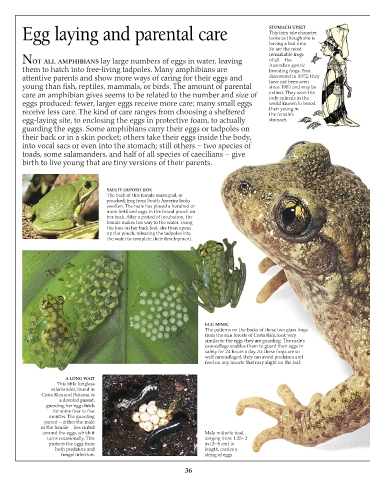
                                    SAFETY DEPOSIT BOX
                                    The back of this female marsupial, or
                                    pouched, frog from South America looks
                                    swollen. The male has placed a hundred or
                                    more fertilized eggs in the brood pouch on
                                    her back. After a period of incubation, the
                                    female makes her way to the water. Using
                                    the toes on her back feet, she then opens
                                    up the pouch, releasing the tadpoles into
                                    the water to complete their development.


                                                                     EGG MIMIC
                                                                     The patterns on the backs of these two glass frogs
                                                                     from the rain forests of Costa Rica, look very
                                                                     similar to the eggs they are guarding. The male’s
                                                                     camouflage enables them to guard their eggs in
                                                                     safety for 24 hours a day. As these frogs are so
                                                                     well camouflaged, they can avoid predators and
                                                                     feed on any insects that may alight on the leaf.


                       A LONG WAIT
                    This little lungless
                  salamander, found in
               Costa Rica and Panama, is
                     a devoted parent,
                guarding her egg clutch
                   for some four to five
                 months. The guarding
                parent – either the male
               or the female – lies curled
               around the eggs, which it                             Male midwife toad,
                 turns occasionally. This                            ranging from 1.25–2
                 protects the eggs from                              in (3–5 cm) in
                   both predators and                                length, carries a
                     fungal infection.                               string of eggs

                                                              3

