


Page 43 - Amphibian
P. 43
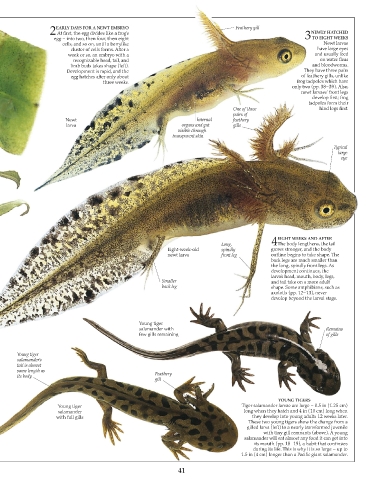
EARLY DAYS FOR A NEWT EMBRYO                               Feathery gill
                 2 At first, the egg divides like a frog’s                                              NEWLY HATCHED
                   egg – into two, then four, then eight                                              3 TO EIGHT WEEKS
                      cells, and so on, until a berrylike                                                   Newt larvae
                        cluster of cells forms. After a                                                   have large eyes
                        week or so, an embryo with a                                                     and usually feed
                         recognizable head, tail, and                                                      on water fleas
                        limb buds takes shape (left).                                                   and bloodworms.
                       Development is rapid, and the                                                  They have three pairs
                        egg hatches after only about                                                 of feathery gills, unlike
                                   three weeks.                                                    frog tadpoles which have
                                                                                                  only two (pp. 38–39). Also,
                                                                                                     newt larvaes’ front legs
                                                                                                        develop first; frog
                                                                                                       tadpoles form their
                                                                              One of three                 hind legs first.
                                                                              pairs of
                       Newt                                       Internal    feathery
                       larva                                 organs and gut   gills
                                                            visible through
                                                          transparent skin
                                                                                                               Typical
                                                                                                                 large
                                                                                                                  eye


                                                                                             EIGHT WEEKS AND AFTER
                                                                          Long,            4The body lengthens, the tail
                                                        Eight-week-old    spindly          grows stronger, and the body
                                                        newt larva        front leg        outline begins to take shape. The
                                                                                           back legs are much smaller than
                                                                                           the long, spindly front legs. As
                                                                                           development continues, the
                                                                                           larva’s head, mouth, body, legs,
                                                       Smaller                             and tail take on a more adult
                                                       back leg                            shape. Some amphibians, such as
                                                                                           axolotls (pp. 12–13), never
                                                                                           develop beyond the larval stage.


                                               Young tiger
                                               salamander with                                               Remains
                                               few gills remaining                                           of gills


       Young tiger
       salamander’s
       tail is almost
       same length as
       its body                                     Feathery
                                                    gill


                                                                                             YOUNG TIGERS
                    Young tiger                                                  Tiger salamander larvae are large – 0.5 in (1.25 cm)
                    salamander                                                    long when they hatch and 4 in (10 cm) long when
                    with full gills                                                 they develop into young adults 12 weeks later.
                                                                                   These two young tigers show the change from a
                                                                                   gilled larva (left) to a nearly transformed juvenile
                                                                                        with tiny gill remnants (above). A young
                                                                                  salamander will eat almost any food it can get into
                                                                                     its mouth (pp. 18–19), a habit that continues
                                                                                     during its life. This is why it is so large – up to
                                                                                 1.5 in (4 cm) longer than a Pacific giant salamander.

                                                            41

