


Page 39 - Amphibian
P. 39
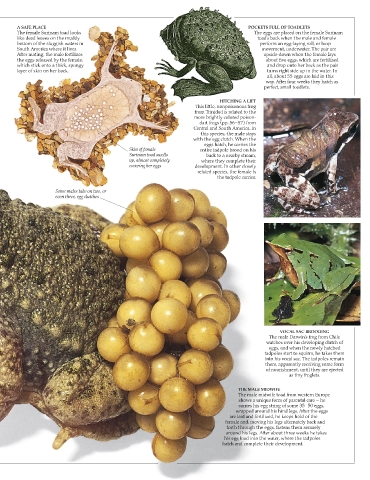
A SAFE PLACE                                                                POCKETS FULL OF TOADLETS
       The female Surinam toad looks                                                 The eggs are placed on the female Surinam
       like dead leaves on the muddy                                                  toad’s back when the male and female
       bottom of the sluggish waters in                                                perform an egg-laying roll, or loop
       South America where it lives.                                                    movement, underwater. The pair are
       After mating, the male fertilizes                                                upside-down when the female lays
       the eggs released by the female,                                                  about five eggs, which are fertilized
       which stick onto a thick, spongy                                                  and drop onto her back as the pair
       layer of skin on her back.                                                        turns right side up in the water. In
                                                                                         all, about 55 eggs are laid in this
                                                                                         way. After four weeks they hatch as
                                                                                        perfect, small toadlets.

                                                                          HITCHING A LIFT
                                                                  This little, nonpoisonous frog
                                                                 from Trinidad is related to the
                                                                 more brightly colored poison-
                                                                   dart frogs (pp. 56–57) from
                                                                 Central and South America. In
                                                                   this species, the male stays
                                                                 with the egg clutch. When the
                                                                     eggs hatch, he carries the
                                            Skin of female         entire tadpole brood on his
                                            Surinam toad swells      back to a nearby stream,
                                            up, almost completely   where they complete their
                                            covering her eggs    development. In other closely
                                                                  related species, the female is
                                                                         the tadpole carrier.

                   Some males take on two, or
                   even three, egg clutches


                                                                                              VOCAL SAC BROODING
                                                                                          The male Darwin’s frog from Chile
                                                                                         watches over his developing clutch of
                                                                                          eggs, and when the newly hatched
                                                                                         tadpoles start to squirm, he takes them
                                                                                         into his vocal sac. The tadpoles remain
                                                                                         there, apparently receiving some form
                                                                                         of nourishment, until they are ejected
                                                                                                 as tiny froglets.

                                                                                THE MALE MIDWIFE
                                                                                The male midwife toad from western Europe
                                                                                shows a unique form of parental care – he
                                                                                carries his egg string of some 35–50 eggs,
                                                                               wrapped around his hind legs. After the eggs
                                                                             are laid and fertilized, he keeps hold of the
                                                                            female and, moving his legs alternately back and
                                                                            forth through the eggs, fastens them securely
                                                                            around his legs. After about three weeks he takes
                                                                           his egg load into the water, where the tadpoles
                                                                           hatch and complete their development.

