


Page 40 - Amphibian
P. 40
Very short
        tail                Metamorphosis                                             Twisting
                                                                                      embryo

                            Metamorphosis means “change of body form and
           NOW A FROGLET    appearance.” Amphibians are the only four-limbed,
         At 12 weeks, the tail has
         been reduced to a bud   or land, vertebrates (animals with a backbone) to
         and will soon disappear.
          The froglets will leave   go through a metamorphosis – that is, a change
         the water shortly or may   from the larval, or tadpole, state into an adult.
         have already left. Every
         generation re-enacts the   This change is easier to see in frogs and toads
         water-to-land transition   than in other amphibians (pp. 40–41). Frog and
         that occurred in the first
         amphibians (pp. 8–9).  toad larvae look completely different from their
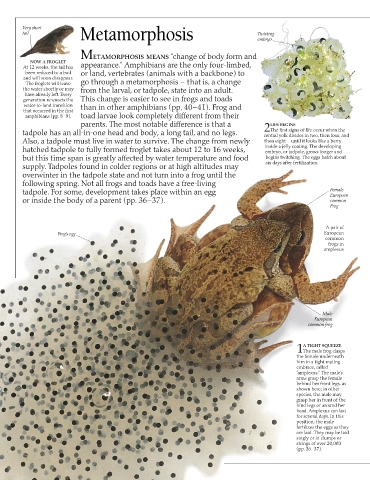
                            parents. The most notable difference is that a                LIFE BEGINS
        tadpole has an all-in-one head and body, a long tail, and no legs.              2The first signs of life occur when the
                                                                                        central yolk divides in two, then four, and
        Also, a tadpole must live in water to survive. The change from newly             then eight – until it looks like a berry
        hatched tadpole to fully formed froglet takes about 12 to 16 weeks,              inside a jelly coating. The developing
                                                                                         embryo, or tadpole, grows longer and
        but this time span is greatly affected by water temperature and food             begins twitching. The eggs hatch about
        supply. Tadpoles found in colder regions or at high altitudes may                six days after fertilization.
        overwinter in the tadpole state and not turn into a frog until the
        following spring. Not all frogs and toads have a free-living
        tadpole. For some, development takes place within an egg                                              Female
                                                                                                              European
        or inside the body of a parent (pp. 36–37).                                                           common
                                                                                                              Frog


                                                                                                             A pair of
                    Frog’s egg                                                                              European
                                                                                                             common
                                                                                                              frogs in
                                                                                                            amplexus


                                                                                                            Male
                                                                                                         European
                                                                                                       common frog


                                                                                                     A TIGHT SQUEEZE
                                                                                                   1The male frog clasps
                                                                                                   the female underneath
                                                                                                   him in a tight mating
                                                                                                   embrace, called
                                                                                                   “amplexus.” The male’s
                                                                                                   arms grasp the female
                                                                                                   behind her front legs, as
                                                                                                   shown here; in other
                                                                                                   species, the male may
                                                                                                   grasp her in front of the
                                                                                                   hind legs or around her
                                                                                                   head. Amplexus can last
                                                                                                   for several days. In this
                                                                                                   position, the male
                                                                                                   fertilizes the eggs as they
                                                                                                   are laid. They may be laid
                                                                                                   singly or in clumps or
                                                                                                   strings of over 20,000
                                                                                                   (pp. 36–37).

