


Page 164 - (DK) Home Doctor: Providing practical advice on home treatments
P. 164
162 FIRST AID

         Head injuries


              All head injuries are potentially serious. A blow to the head may
                                                                            WARNING
              cause a bruise or scalp injury and sometimes a concussion, a brief
              period of unconsciousness. There is a risk of an underlying skull  Call 911 immediately if:
              fracture, as well as compression of the brain from bleeding inside  ● There is severe bleeding and/or
                                                                     blood or watery fluid is leaking
              the skull or swelling of injured brain tissues. Symptoms, such as
                                                                     from the ears or nose
              intense headaches, noisy, slow breathing, and drowsiness, may  ● A victim loses consciousness
              develop hours or even days after the injury. Anyone with a head
              injury should also be treated for a potential neck (spinal) injury.


         What you can do yourself
                                                                PRACTICAL TECHNIQUE
              You should seek medical advice for all head
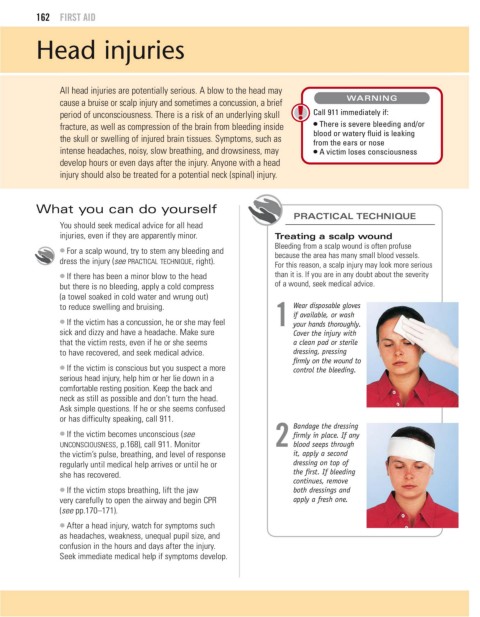
              injuries, even if they are apparently minor.   Treating a scalp wound
                                                            Bleeding from a scalp wound is often profuse
              ● For a scalp wound, try to stem any bleeding and
                                                            because the area has many small blood vessels.
              dress the injury (see PRACTICAL TECHNIQUE, right).
                                                            For this reason, a scalp injury may look more serious
              ● If there has been a minor blow to the head   than it is. If you are in any doubt about the severity
              but there is no bleeding, apply a cold compress  of a wound, seek medical advice.
              (a towel soaked in cold water and wrung out)
              to reduce swelling and bruising.                  Wear disposable gloves
                                                                if available, or wash
              ● If the victim has a concussion, he or she may feel  1 your hands thoroughly.
              sick and dizzy and have a headache. Make sure     Cover the injury with
              that the victim rests, even if he or she seems    a clean pad or sterile
              to have recovered, and seek medical advice.       dressing, pressing
                                                                firmly on the wound to
              ● If the victim is conscious but you suspect a more  control the bleeding.
              serious head injury, help him or her lie down in a
              comfortable resting position. Keep the back and
              neck as still as possible and don’t turn the head.
              Ask simple questions. If he or she seems confused
              or has difficulty speaking, call 911.
                                                                Bandage the dressing
              ● If the victim becomes unconscious (see          firmly in place. If any
              UNCONSCIOUSNESS, p.168), call 911. Monitor    2 blood seeps through
              the victim’s pulse, breathing, and level of response  it, apply a second
              regularly until medical help arrives or until he or  dressing on top of
              she has recovered.                                the first. If bleeding
                                                                continues, remove
              ● If the victim stops breathing, lift the jaw     both dressings and
              very carefully to open the airway and begin CPR   apply a fresh one.
              (see pp.170–171).
              ● After a head injury, watch for symptoms such
              as headaches, weakness, unequal pupil size, and
              confusion in the hours and days after the injury.
              Seek immediate medical help if symptoms develop.

