


Page 159 - (DK) Home Doctor: Providing practical advice on home treatments
P. 159
FIRST AID  157

         Severe bleeding


              Severe bleeding is likely to be distressing both for the victim
                                                                            WARNING
              and for the person who is assisting. It is usually the result of
              a serious injury such as a stab wound, a severe blow, or a  Dial 911 or call EMS.
              deep cut. The main priorities are to stop the bleeding then to  Profuse or prolonged bleeding can
                                                                     be life-threatening.
              monitor the victim’s condition continually. If a large amount of
              blood is lost, life-threatening shock may develop.


                                         PRACTICAL TECHNIQUE
              Treating severe bleeding                   to reduce the risk of infection. You then need to check
              While you wait for medical help to arrive, your immediate  that the bandage is not restricting circulation. You should
              priority is to stem the flow of blood. Once you have done  also watch the victim for signs of shock (see p.165)
              this, you need to dress the wound as quickly as possible  and try to prevent or minimize its effects.


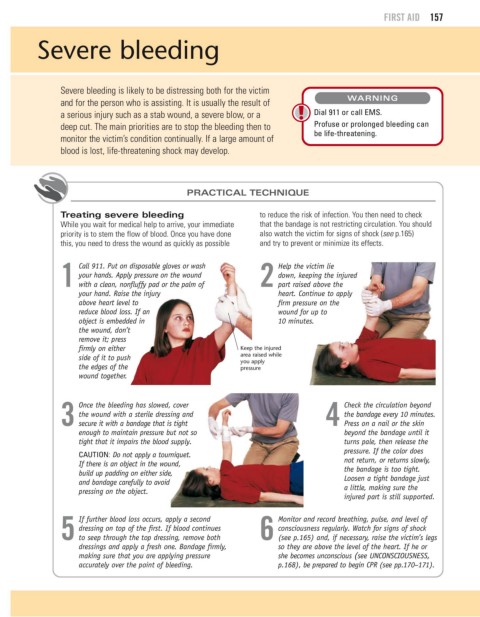
                  Call 911. Put on disposable gloves or wash  Help the victim lie
                  your hands. Apply pressure on the wound    down, keeping the injured
              1 with a clean, nonfluffy pad or the palm of   2 part raised above the
                  your hand. Raise the injury                heart. Continue to apply
                  above heart level to                       firm pressure on the
                  reduce blood loss. If an                   wound for up to
                  object is embedded in                      10 minutes.
                  the wound, don’t
                  remove it; press
                  firmly on either                   Keep the injured
                  side of it to push                 area raised while
                                                     you apply
                  the edges of the                   pressure
                  wound together.

                  Once the bleeding has slowed, cover                      Check the circulation beyond
                  the wound with a sterile dressing and                    the bandage every 10 minutes.
              3 secure it with a bandage that is tight                 4 Press on a nail or the skin
                  enough to maintain pressure but not so                   beyond the bandage until it
                  tight that it impairs the blood supply.                  turns pale, then release the
                                                                           pressure. If the color does
                  CAUTION: Do not apply a tourniquet.                      not return, or returns slowly,
                  If there is an object in the wound,                      the bandage is too tight.
                  build up padding on either side,
                  and bandage carefully to avoid                           Loosen a tight bandage just
                  pressing on the object.                                  a little, making sure the
                                                                           injured part is still supported.

                  If further blood loss occurs, apply a second  Monitor and record breathing, pulse, and level of
                  dressing on top of the first. If blood continues  consciousness regularly. Watch for signs of shock
              5 to seep through the top dressing, remove both  6 (see p.165) and, if necessary, raise the victim’s legs
                  dressings and apply a fresh one. Bandage firmly,  so they are above the level of the heart. If he or
                  making sure that you are applying pressure  she becomes unconscious (see UNCONSCIOUSNESS,
                  accurately over the point of bleeding.     p.168), be prepared to begin CPR (see pp.170–171).

