


Page 163 - (DK) Home Doctor: Providing practical advice on home treatments
P. 163
FIRST AID  161

         Fractures and dislocations


              A fracture is a break or crack in a bone due to a heavy blow or
                                                                            WARNING
              a sudden twist or wrench. In open fractures, the bone protrudes
              through the skin; in closed fractures, the skin is not broken.  Get medical attention immediately
                                                                     if you suspect a broken bone or a
              In a dislocation, the bones of a joint are pulled apart. Signs of
                                                                     dislocated joint. If a person with
              a broken bone or dislocated joint include swelling, bruising, and  a broken arm can bend the injured
              deformity at the site of the injury, and pain and difficulty moving  arm, take him or her to the hospital
              the affected part. A serious fracture, for example of the thigh  by car. Otherwise, call 911.
              bone, may cause severe internal bleeding and shock (see p.165).


                                         PRACTICAL TECHNIQUE
              Treating a broken arm                      Treating a broken leg or pelvis
              Your main goals are to treat any bleeding, support the  Your main goals are to protect the injured part, call 911,
              injury, and arrange transportation to a hospital. Don’t move  and, for a broken leg, treat any bleeding. Don’t move the
              the person until the arm has been immobilized, unless he  victim until the injured part has been immobilized, unless
              or she is in danger. Treat dislocations in the same way.  he or she is in danger. Never attempt to manipulate the
              Never attempt to manipulate bones back into place.   bones back into place.
                  If the victim can bend the injured arm, ask him or  Call 911. If a bone is protruding, put on disposable
                  her to support it. If the bone is protruding from  gloves, if available, then loosely cover the wound
              1 the wound, put on disposable gloves, if available.  1 with a clean or sterile dressing. Apply pressure
                  Cover the wound with a clean dressing. Apply pressure  to control bleeding, but be careful not to press on
                  to control bleeding, but don’t press on the bone end.  the bone end.
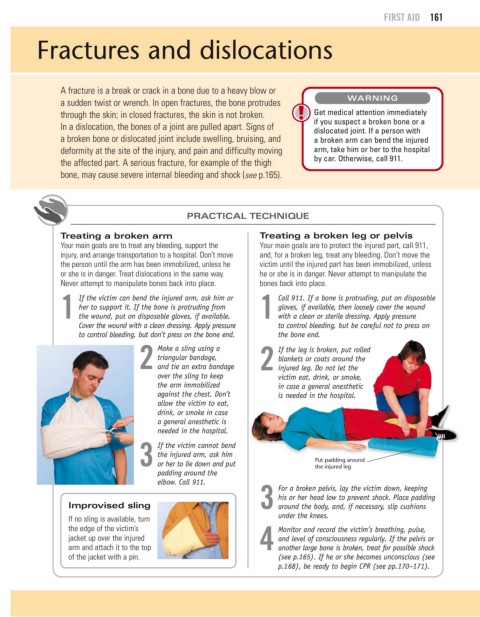
                                   Make a sling using a      If the leg is broken, put rolled
                                   triangular bandage,       blankets or coats around the
                               2 and tie an extra bandage 2 injured leg. Do not let the
                                   over the sling to keep    victim eat, drink, or smoke,
                                   the arm immobilized       in case a general anesthetic
                                   against the chest. Don’t  is needed in the hospital.
                                   allow the victim to eat,
                                   drink, or smoke in case
                                   a general anesthetic is
                                   needed in the hospital.
                                   If the victim cannot bend
                                   the injured arm, ask him
                               3 or her to lie down and put          Put padding around
                                                                     the injured leg
                                   padding around the
                                   elbow. Call 911.
                                                             For a broken pelvis, lay the victim down, keeping
                                                             his or her head low to prevent shock. Place padding
                Improvised sling                         3 around the body, and, if necessary, slip cushions
                If no sling is available, turn               under the knees.
                the edge of the victim’s                     Monitor and record the victim’s breathing, pulse,
                jacket up over the injured                   and level of consciousness regularly. If the pelvis or
                arm and attach it to the top             4 another large bone is broken, treat for possible shock
                of the jacket with a pin.                    (see p.165). If he or she becomes unconscious (see
                                                             p.168), be ready to begin CPR (see pp.170–171).

