


Page 161 - (DK) Home Doctor: Providing practical advice on home treatments
P. 161
FIRST AID  159

         Anaphylactic shock


              Certain people develop this life-threatening allergic reaction
                                                                            WARNING
              to insect stings, to some foods such as peanuts or shellfish,
              or to certain drugs. Anaphylactic shock develops within minutes  Dial 911 or call EMS.
              and causes a sudden drop in blood pressure and narrowing of  A person with anaphylactic shock
                                                                     needs urgent medical attention.
              the airways. Symptoms include wheezing; swelling around the
              eyes and of the face, lips, and tongue; widespread red, blotchy
              skin eruptions; gasping for air; and anxiety. There is a risk of
              shock (see p.165), and the person may become unconscious.


                                         PRACTICAL TECHNIQUE

              Treating anaphylactic shock                allergic reaction often carry a prefilled syringe of epinephrine
              Your goal is to get the victim to a hospital immediately.  (adrenaline) for self-treatment, but may need your help to
              A person with anaphylactic shock needs emergency  use it. While you wait for specialized help to arrive, you
              medical help, including an injection of epinephrine  should try to ease the victim’s breathing, watch him or her
              (adrenaline). People who are susceptible to this type of  carefully for any signs of shock, and treat if necessary.

                  Call 911. Tell the dispatcher that you suspect
                  anaphylactic shock, and give any information
              1 you have on what has triggered the reaction.
                                                         Help the victim
                  The victim may be able to give you the details.  to find and use his
                                                         or her epinephrine
                                                         (adrenaline) syringe
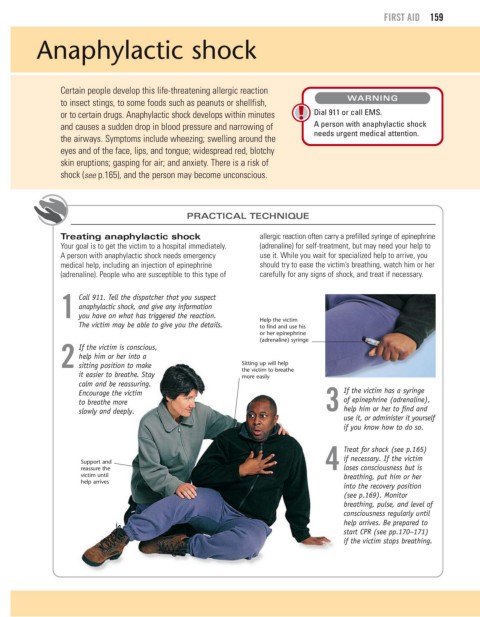
                  If the victim is conscious,
                  help him or her into a
              2 sitting position to make             Sitting up will help
                                                     the victim to breathe
                  it easier to breathe. Stay         more easily
                  calm and be reassuring.
                  Encourage the victim                                     If the victim has a syringe
                  to breathe more                                          of epinephrine (adrenaline),
                  slowly and deeply.                                   3 help him or her to find and
                                                                           use it, or administer it yourself
                                                                           if you know how to do so.

                                                                           Treat for shock (see p.165)
                                                                           if necessary. If the victim
                  Support and
                  reassure the                                         4 loses consciousness but is
                  victim until                                             breathing, put him or her
                  help arrives
                                                                           into the recovery position
                                                                           (see p.169). Monitor
                                                                           breathing, pulse, and level of
                                                                           consciousness regularly until
                                                                           help arrives. Be prepared to
                                                                           start CPR (see pp.170–171)
                                                                           if the victim stops breathing.

