


Page 116 - (DK Eyewitness) Travel Guide - Rome
P. 116
114 ROME AREA B Y AREA
e Pantheon
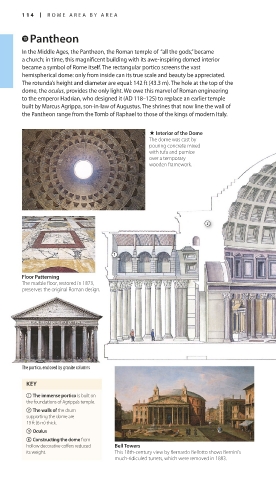
In the Middle Ages, the Pantheon, the Roman temple of “all the gods,” became
a church; in time, this magnificent building with its awe-inspiring domed interior
became a symbol of Rome itself. The rectangular portico screens the vast
hemispherical dome: only from inside can its true scale and beauty be appreciated.
The rotunda’s height and diameter are equal: 142 ft (43.3 m). The hole at the top of the
dome, the oculus, provides the only light. We owe this marvel of Roman engineering
to the emperor Hadrian, who designed it (AD 118–125) to replace an earlier temple
built by Marcus Agrippa, son-in-law of Augustus. The shrines that now line the wall of
the Pantheon range from the Tomb of Raphael to those of the kings of modern Italy.
. Interior of the Dome
The dome was cast by
pouring concrete mixed
with tufa and pumice
over a temporary
wooden framework.
Floor Patterning
The marble floor, restored in 1873,
preserves the original Roman design.
The portico, enclosed by granite columns
KEY
1 The immense portico is built on
the foundations of Agrippa’s temple.
2 The walls of the drum
supporting the dome are
19 ft (6 m) thick.
3 Oculus
4 Constructing the dome from
hollow decorative coffers reduced Bell Towers
its weight. This 18th-century view by Bernardo Bellotto shows Bernini’s
much-ridiculed turrets, which were removed in 1883.
US_114-115_EW_Rome_US.indd 114 19/04/2017 12:34
Eyewitness Travel LAYERS PRINTED:
Starsight template “UK” LAYER
(Source v1.9)
Date 28th August 2012
Size 125mm x 217mm

