


Page 111 - (DK Eyewitness) Travel Guide - Rome
P. 111
PIAZZA DELLA RO T OND A 109
5 Fontanella del Occasionally, the gallery hosts
Facchino concerts and evening visits
of the collection.
Via Lata. Map 5 A4 & 12 E3. @ 64,
81, 85, 117, 119, 492, and many
other routes. 7 Via della Gatta
Il Facchino (the Porter), once Map 5 A4 & 12 E3. @ 62, 63, 64, 70,
in the Corso, now set in the 81, 87, 186, 492 & routes along Via del
wall of the Banco di Roma, was Plebiscito & Corso Vittorio Emanuele II.
one of Rome’s “talking statues”
like Pasquino (see p126). Created This narrow street runs
around 1590, the fountain bet ween the Palazzo Doria
may have been based on a Pamphilj and the smaller
drawing by painter Jacopino The facade of the Rococo palace building, Palazzo Grazioli. The ancient
del Conte. The statue of a man Palazzo Doria Pamphilj marble sculpture of a cat (gatta)
holding a barrel most likely that gives the street its name is
represents a member of the theater inaugurated by Queen on the first cornice on the
Università degli Acquaroli Christina of Sweden in 1684. corner of Palazzo Grazioli.
(Fraternity of Water-carriers), In the first half of the 1700s,
though it is also said to be of Gabriele Valvassori created the
Martin Luther, or of the porter gallery above the courtyard, 8 Palazzo Altieri
Abbondio Rizzio, who died and a new facade along Via del Gesù 49. Map 4 F4 & 12 E3.
carrying a barrel. the Corso, using the highly @ 46, 62, 63, 64, 70, 81, 87, 186, 492,
decorative style of the period, and routes along Via del Plebiscito and
Rococo, which now dominates Corso Vittorio Emanuele II. v 8.
the building. The stairways, Closed to the public.
and salons, the Mirror Gallery,
and the picture gallery all The Altieri family is first
radiate a sense of light mentioned in Rome’s history in
and space. the 9th century. This palazzo
The family collection in the was built by the last male
Doria Pamphilj gallery has over heirs, the brothers Cardinal
400 paintings dating from the Giambattista di Lorenzo Altieri
The Facchino drinking fountain 15th to the 18th centuries, and Cardinal Emilio Altieri, who
including the famous portrait later became Pope Clement X
6 Palazzo Doria of Pope Innocent X Pamphilj by (reigned 1670–76). Many
surrounding houses had to be
Velázquez. There are also works
Pamphilj by Titian, Caravaggio, Lorenzo demolished, but an old woman
Lotto, and Guercino. The rooms called Berta refused to leave, so
Via del Corso 305. Map 5 A4 & 12 E3.
Tel 06-679 7323. @ 64, 81, 85, 117, in the private apartment still her hovel was incorporated in
119, 492, and many other routes. have many of their original the palazzo. Its windows are
Open 9am–7pm daily. Closed Jan 1, furnishings, including splendid still visible on the west end of
Easter Sun, Dec 25. & 7 8 for Brussels and Gobelin tapestries. the building.
private apartments. 9 = -
Concerts. ∑ doriapamphilj.it
Palazzo Doria Pamphilj is a great
island of stone in the heart of
Rome, the oldest parts dating
from 1435. Through the Corso
entrance you can see the 16th-
century porticoed courtyard
with the coat of arms of the della
Rovere family. The Aldobrandini
were the next owners. Between
1601 and 1647 the mansion
acquired a second courtyard and
flanking wings at the expense of
a public bath that stood nearby.
When the Pamphilj family
took over, they completed the
Piazza del Collegio Romano
facade and the Via della Gatta
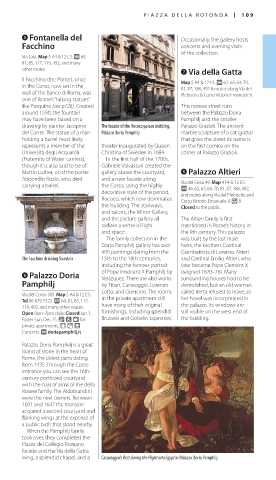
wing, a splendid chapel, and a Caravaggio’s Rest during the Flight into Egypt in Palazzo Doria Pamphilj
US_108-109_EW_Rome_US.indd 109 15/03/17 4:19 pm

