


Page 114 - (DK Eyewitness) Travel Guide - Rome
P. 114
112 ROME AREA B Y AREA
wished to be remembered. w Obelisk of Santa
Note the Cosma tesque Maria sopra
13th-century tombs, and the Minerva
exquisite works of 15th-century
Tuscan and Venetian artists. Piazza della Minerva. Map 4 F4 & 12
Local talent of the period can D3. @ 116 and routes along Via del
be admired in Antoniazzo Corso and Corso Vittorio Emanuele II.
Romano’s Annunciation,
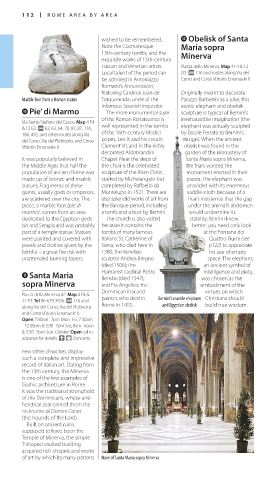
featuring Cardinal Juan de Originally meant to decorate
Marble foot from a Roman statue Torquemada, uncle of the Palazzo Barberini as a joke, this
infamous Spanish Inquisitor. exotic elephant and obelisk
0 Pie’ di Marmo The more monumental style sculpture is typical of Bernini’s
of the Roman Renaissance is inexhaustible imagination (the
Via Santo Stefano del Cacco. Map 4 F4
& 12 E3. @ 62, 63, 64, 70, 81, 87, 116, well represented in the tombs elephant was actually sculpted
186, 492, and other routes along Via of the 16th-century Medici by Ercole Ferrata to Bernini’s
del Corso, Via del Plebiscito, and Corso popes, Leo X and his cousin design). When the ancient
Vittorio Emanuele II. Clement VII, and in the richly obelisk was found in the
decorated Aldobrandini garden of the monastery of
It was popularly believed in Chapel. Near the steps of Santa Maria sopra Minerva,
the Middle Ages that half the the choir is the celebrated the friars wanted the
population of ancient Rome was sculpture of the Risen Christ, monument erected in their
made up of bronze and marble started by Michelangelo but piazza. The elephant was
statues. Fragments of these completed by Raffaello da provided with its enormous
giants, usually gods or emperors, Montelupo in 1521. There are saddle-cloth because of a
are scattered over the city. This also splendid works of art from friar’s insis tence that the gap
piece, a marble foot (pie’ di the Baroque period, including under the animal’s abdomen
marmo), comes from an area a tomb and a bust by Bernini. would undermine its
dedicated to the Egyptian gods The church is also visited stability. Bernini knew
Isis and Serapis and was probably because it contains the better: you need only look
part of a temple statue. Statues tombs of many famous at the Fontana dei
were painted and covered with Italians: St. Catherine of Quattro Fiumi (see
jewels and clothes given by the Siena, who died here in p122) to appreciate
faithful – a great fire risk with 1380; the Venetian his use of empty
unattended burning tapers. sculptor Andrea Bregno space. The elephant,
(died 1506); the an ancient symbol of
intelligence and piety,
q Santa Maria Humanist cardinal Pietro was chosen as the
Bembo (died 1547);
sopra Minerva and Fra Angelico, the embodiment of the
Dominican friar and virtues on which
Piazza della Minerva 42. Map 4 F4 &
12 E3. Tel 06-679 3926. @ 116 and painter, who died in Bernini’s marble elephant Christians should
along Via del Corso, Via del Plebiscito Rome in 1455. and Egyptian obelisk build true wisdom.
and Corso Vittorio Emanuele II.
Open 7:30am–7pm Mon–Fri, 7:30am
–12:30pm & 3:30–7pm Sat, 8am–noon
& 3:30–7pm Sun. Cloister: Open call in
advance for details. 5 9 Concerts.
Few other churches display
such a complete and im pressive
record of Italian art. Dating from
the 13th century, the Minerva
is one of the few examples of
Gothic architecture in Rome.
It was the traditional stronghold
of the Dominicans, whose anti-
heretical zeal earned them the
nickname of Domini Canes
(the hounds of the Lord).
Built on ancient ruins,
supposed to have been the
Temple of Minerva, the simple
T-shaped vaulted building
acquired rich chapels and works
of art by which its many patrons Nave of Santa Maria sopra Minerva
US_112-113_EW_Rome_US.indd 112 15/03/17 4:20 pm

