


Page 115 - (DK Eyewitness) Travel Guide - Rome
P. 115
PIAZZA DELLA RO T OND A 113
e Pantheon
See pp114–15.
r Sant’Eustachio
Piazza Sant’Eustachio. Map 4 F4 & 12
D3. Tel 06-686 5334. @ 116 and routes
along Corso Vittorio Emanuele II.
Open 9am–noon & 4–7:30pm daily. 5
The origins of this church date
to early Christian times, when
it offered relief to the poor.
In medieval times, many
charitable brotherhoods
elected St. Eustachio as their
patron, and had chapels here.
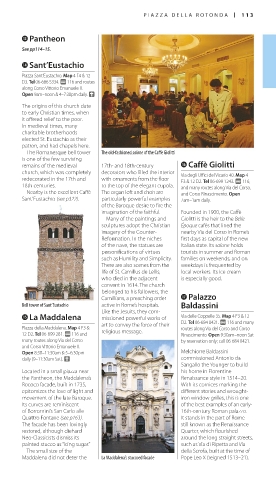
The Romanesque bell tower The old-fashioned salone of the Caffè Giolitti
is one of the few surviving
remains of the medieval 17th- and 18th-century y Caffè Giolitti
church, which was com pletely decorators who filled the interior Via degli Uffici del Vicario 40. Map 4
redecorated in the 17th and with ornaments from the floor F3 & 12 D2. Tel 06-699 1243. @ 116,
18th centuries. to the top of the elegant cupola. and many routes along Via del Corso,
Nearby is the excellent Caffè The organ loft and choir are and Corso Rinascimento. Open
Sant’Eustachio (see p322). particularly powerful examples 7am–1am daily.
of the Baroque desire to fire the
imagination of the faithful. Founded in 1900, the Caffè
Many of the paintings and Giolitti is the heir to the Belle
sculptures adopt the Christian Époque cafés that lined the
imagery of the Counter- nearby Via del Corso in Rome’s
Reformation. In the niches first days as capital of the new
of the nave, the statues are Italian state. Its salone holds
personifications of virtues tourists in summer and Roman
such as Humility and Simplicity. families on weekends, and on
There are also scenes from the weekdays is frequented by
life of St. Camillus de Lellis, local workers. Its ice cream
who died in the adjacent is especially good.
convent in 1614. The church
belonged to his followers, the
Camillians, a preaching order u Palazzo
Bell tower of Sant’Eustachio active in Rome’s hospitals. Baldassini
Like the Jesuits, they com-
t La Maddalena missioned powerful works of Via delle Coppelle 35. Map 4 F3 & 12
art to convey the force of their D2. Tel 06-684 0421. @ 116 and many
Piazza della Maddalena. Map 4 F3 & routes along Via del Corso and Corso
12 D2. Tel 06-899 281. @ 116 and religious message. Rinascimento. Open 9:30am–noon Sat
many routes along Via del Corso by reservation only; call 06-684 0421.
and Corso Vittorio Emanuele II.
Open 8:30–11:30am & 5–6:30pm Melchiorre Baldassini
daily (9–11:30am Sat). 5 commissioned Antonio da
Sangallo the Younger to build
Located in a small piazza near his home in Florentine
the Pantheon, the Maddalena’s Renaissance style in 1514–20.
Rococo facade, built in 1735, With its cornices marking the
epitomizes the love of light and different stories and wrought-
movement of the late Baroque. iron window grilles, this is one
Its curves are reminiscent of the best examples of an early-
of Borromini’s San Carlo alle 16th-century Roman palazzo.
Quattro Fontane (see p163). It stands in the part of Rome
The facade has been lovingly still known as the Renaissance
restored, although diehard Quarter, which flourished
Neo-Classicists dismiss its around the long straight streets,
painted stucco as “icing sugar.” such as Via di Ripetta and Via
The small size of the della Scrofa, built at the time of
Maddalena did not deter the La Maddalena’s stuccoed facade Pope Leo X (reigned 1513–21).
US_112-113_EW_Rome_US.indd 113 15/03/17 4:20 pm

