


Page 40 - (DK Eyewitness) Travel Guide - Rome
P. 40
38 INTRODUCING ROME
Understanding Rome’s Architecture
The architecture of Imperial Rome kept alive the Classical styles
of ancient Greece, at the same time developing new, uniquely
Roman forms based on the arch, the vault, and the dome.
The next important period was the 12th century, when many
Romanesque churches were built. The Renaissance saw a return
to Classical ideals, inspired by the example of Florence, but in
the 17th century Rome found a style of its own again in the
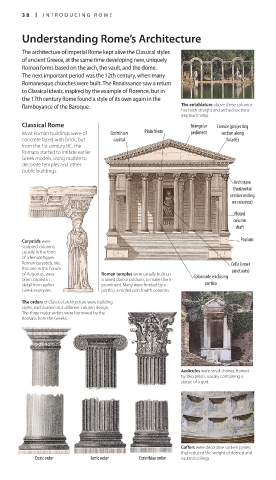
flamboyance of the Baroque. The entablature above these columns
has both straight and arched sections
(Hadrian’s Villa).
Classical Rome Triangular Cornice (projecting
Most Roman buildings were of Corinthian Plain frieze pediment section along
concrete faced with brick, but capital facade)
from the 1st century BC, the
Romans started to imitate earlier
Greek models, using marble to
decorate temples and other
public buildings.
Architrave
(horizontal
section resting
on columns)
Fluted
column
shaft
Caryatids were Podium
sculpted columns,
usually in the form
of a female figure.
Roman caryatids, like Cella (inner
this one in the Forum sanctuary)
of Augustus, were Roman temples were usually built on
often copied in a raised dais or podium, to make them Colonnade enclosing
detail from earlier prominent. Many were fronted by a portico
Greek examples. portico, a roofed porch with columns.
The orders of Classical architecture were building
styles, each based on a different column design.
The three major orders were borrowed by the
Romans from the Greeks.
Aedicules were small shrines, framed
by two pillars, usually containing a
statue of a god.
Coffers were decorative sunken panels
that reduced the weight of domed and
Doric order Ionic order Corinthian order vaulted ceilings.
US_038-039_EW_Rome_US.indd 38 15/03/17 4:19 pm

