


Page 41 - (DK Eyewitness) Travel Guide - Rome
P. 41
THE HIST OR Y OF ROME 39
Early Christian and
Medieval Rome
The first Christian churches in
Rome were based on the basilica:
rectangular, with three naves,
each usually ending in an apse.
From the 10th to the 13th
centuries, most churches were
built in the Romanesque style,
which used the rounded arches
of ancient Rome.
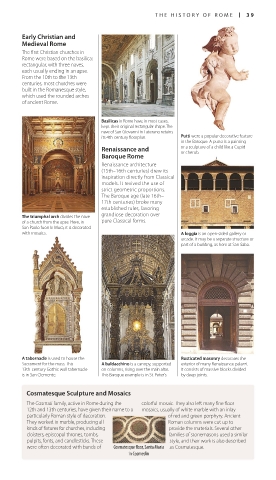
Basilicas in Rome have, in most cases,
kept their original rectangular shape. The
nave of San Giovanni in Laterano retains
its 4th-century floorplan. Putti were a popular decorative feature
in the Baroque. A putto is a painting
Renaissance and or a sculpture of a child like a Cupid
or cherub.
Baroque Rome
Renaissance architecture
(15th–16th centuries) drew its
inspiration directly from Classical
models. It revived the use of
strict geometric proportions.
The Baroque age (late 16th–
17th centuries) broke many
established rules, favoring
The triumphal arch divides the nave grandiose decoration over
of a church from the apse. Here, in pure Classical forms.
San Paolo fuori le Mura, it is decorated
with mosaics. A loggia is an open-sided gallery or
arcade. It may be a separate structure or
part of a building, as here at San Saba.
A tabernacle is used to house the Rusticated masonry decorates the
Sacrament for the mass. This A baldacchino is a canopy, supported exterior of many Renaissance palazzi.
13th-century Gothic wall tabernacle on columns, rising over the main altar. It consists of massive blocks divided
is in San Clemente. This Baroque example is in St. Peter’s. by deep joints.
Cosmatesque Sculpture and Mosaics
The Cosmati family, active in Rome during the colorful mosaic. They also left many fine floor
12th and 13th centuries, have given their name to a mosaics, usually of white marble with an inlay
particularly Roman style of decoration. of red and green porphyry. Ancient
They worked in marble, producing all Roman columns were cut up to
kinds of fixtures for churches, including provide the materials. Several other
cloisters, episcopal thrones, tombs, families of stonemasons used a similar
pulpits, fonts, and candlesticks. These style, and their work is also described
were often decorated with bands of Cosmatesque floor, Santa Maria as Cosmatesque.
in Cosmedin
US_038-039_EW_Rome_US.indd 39 15/03/17 4:19 pm

