


Page 38 - (DK Eyewitness) Travel Guide - Rome
P. 38
36 INTRODUCING ROME
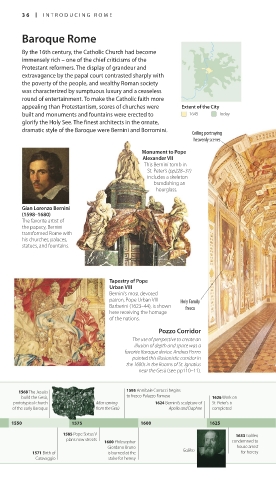
Baroque Rome
By the 16th century, the Catholic Church had become
immensely rich – one of the chief criticisms of the
Protestant reformers. The display of grandeur and
extravagance by the papal court contrasted sharply with
the poverty of the people, and wealthy Roman society
was characterized by sumptuous luxury and a ceaseless
round of entertainment. To make the Catholic faith more
appealing than Protestantism, scores of churches were Extent of the City
built and monuments and fountains were erected to 1645 Today
glorify the Holy See. The finest architects in the ornate,
dramatic style of the Baroque were Bernini and Borromini.
Ceiling portraying
heavenly scenes
Monument to Pope
Alexander VII
This Bernini tomb in
St. Peter’s (pp228–31)
includes a skeleton
brandishing an
hourglass.
Gian Lorenzo Bernini
(1598–1680)
The favorite artist of
the papacy, Bernini
transformed Rome with
his churches, palaces,
statues, and fountains.
Tapestry of Pope
Urban VIII
Bernini’s most devoted
patron, Pope Urban VIII Holy Family
Barberini (1623–44), is shown fresco
here receiving the homage
of the nations.
Pozzo Corridor
The use of perspective to create an
illusion of depth and space was a
favorite Baroque device. Andrea Pozzo
painted this illusionistic corridor in
the 1680s in the Rooms of St. Ignatius
near the Gesù (see pp110–11).
1568 The Jesuits 1595 Annibale Carracci begins 1651 Bernini
build the Gesù, to fresco Palazzo Farnese 1626 Work on redesigns
prototypical church Altar carving 1624 Bernini’s sculpture of St. Peter’s is much of
of the early Baroque from the Gesù Apollo and Daphne completed Piazza Navona
1550 1575 1600 1625 1650
1585 Pope Sixtus V 1633 Galileo
plans new streets
1600 Philosopher condemned to
Giordano Bruno house arrest
1571 Birth of is burned at the Galileo for heresy
Caravaggio stake for heresy
US_036-037_EW_Rome_US.indd 36 15/03/17 4:19 pm

