


Page 52 - All About History - Issue 56-17
P. 52
Hero or Villain?
        SIR ROBERT PEEL
        JOHN DEE


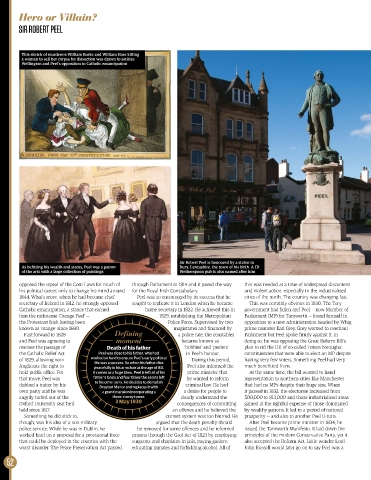
         This sketch of murderers William Burke and William Hare killing
         a woman to sell her corpse for dissection was drawn to satirise
         Wellington and Peel’s opposition to Catholic emancipation


                                                                Sir Robert Peel is honoured by a statue in
         As befitting his wealth and status, Peel was a patron   Bury, Lancashire, the town of his birth. A JD
         of the arts with a large collection of paintings       Wetherspoon pub is also named after him

        opposed the repeal of the Corn Laws for much of   through Parliament in 1814 and it paved the way    this was needed at a time of widespread discontent
        his political career, only to change his mind around   for the Royal Irish Constabulary.  and violent action, especially in the industrialised
        1844. What’s more, when he had become chief   Peel was so encouraged by its success that he   cities of the north. The country was changing fast.
        secretary of Ireland in 1812, he strongly opposed   sought to replicate it in London when he became   This was certainly obvious in 1830. The Tory
        Catholic emancipation, a stance that earned   home secretary in 1822. He achieved this in   government had fallen and Peel — now Member of
        him the nickname ‘Orange Peel’ —                 1829, establishing the Metropolitan   Parliament (MP) for Tamworth — found himself in
        the Protestant Irish having been                    Police Force. Supervised by two   opposition to a new administration headed by Whig
        known as ‘orange’ since 1690.                         magistrates and financed by   prime minister Earl Grey. Grey wanted to overhaul
          Fast-forward to 1828           Defining               a police rate, the constables   Parliament but Peel spoke firmly against it. In
        and Peel was agreeing to          moment                 became known as       doing so, he was opposing the Great Reform Bill’s
        oversee the passage of         Death of his father        ‘bobbies’ and ‘peelers’    plan to rid the UK of so-called ‘rotten boroughs’,
        the Catholic Relief Act     Peel was close to his father, who had   in Peel’s honour.  constituencies that were able to elect an MP despite
        of 1829, allowing non-   worked so hard to ensure Peel’s early political   During this period,   having very few voters. Something Peel had very
                                  life was a success. So when his father dies
        Anglicans the right to    peacefully in his armchair at the age of 80,   Peel also informed the   much benefitted from.
        hold public office. For   it comes as a huge blow. Peel is left all of his   prime minister that   At the same time, the bill wanted to hand
        that move, Peel was       father’s lands and four times the assets left   he wanted to reform   representation to northern cities like Manchester
                                  to his other sons. He decides to demolish
        dubbed a traitor by his                                   criminal law. He had   that had no MPs despite their huge size. When
                                    Drayton Manor and replaces it with
        own party and he was         a grand mansion incorporating a   a desire for people to   it passed in 1832, the electorate increased from
        angrily turfed out of the        three-storey tower.     clearly understand the   500,000 to 813,000 and those industrialised areas
        Oxford University seat he’d       3 May 1830           consequences of committing   gained at the rightful expense of those dominated
        held since 1817.                                      an offence and he believed the   by wealthy patrons. It led to a period of national
          Something he did stick to,                       current system was too blurred. He   prosperity — and also to another Peel U-turn.
        though, was his idea of a non-military          argued that the death penalty should   After Peel became prime minister in 1834, he
        police service. While he was in Dublin, he   be removed for some offences and he reformed   issued the Tamworth Manifesto. It laid down the
        worked hard on a proposal for a provisional force   prisons through the Gaol Act of 1823 by employing   principles of the modern Conservative Party, yet it
        that could be deployed in the counties with the   surgeons and chaplains in jails, paying gaolers,   also accepted the Reform Act. Little wonder Lord
        worst disorder. The Peace Preservation Act passed   educating inmates and forbidding alcohol. All of   John Russell would later go on to say Peel was a
   52

