


Page 53 - All About History - Issue 56-17
P. 53
Hero or Villain?
                                                                                                             SIR ROBERT PEEL


                                                             Defining
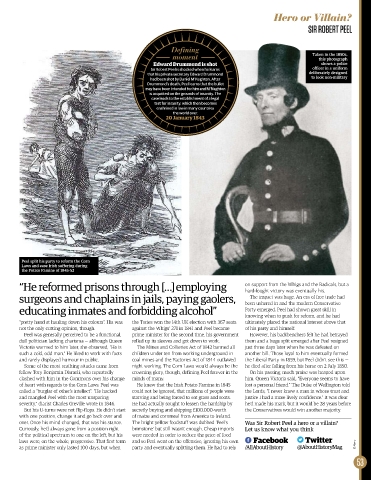
                                                              moment                                           Taken in the 1850s,
                                                                                                                 this photograph
                                                       Edward Drummond is shot                                    shows a police
                                                      Sir Robert Peel is shocked when he learns                officer in a uniform
                                                     that his private secretary Edward Drummond               deliberately designed
                                                      had been shot by Daniel M’Naghten. After                to look non-military
                                                     Drummond’s death, Peel learns that the bullet
                                                    may have been intended for him and M’Naghten
                                                      is acquitted on the grounds of insanity. The
                                                      case leads to the establishment of a legal
                                                       test for insanity, which then becomes
                                                        enshrined in law in many countries
                                                              the world over.
                                                           20 January 1843


         Peel split his party to reform the Corn
         Laws and ease Irish suffering during
         the Potato Famine of 1845-52

        “He reformed prisons through […]employing                                      on support from the Whigs and the Radicals, but a

                                                                                       hard-fought victory was eventually his.
        surgeons and chaplains in jails, paying gaolers,                                 The impact was huge. An era of free trade had
                                                                                       been ushered in and the modern Conservative
        educating inmates and forbidding alcohol”                                      Party emerged. Peel had shown great skill in
                                                                                       knowing when to push for reform, and he had
        “pretty hand at hauling down his colours”. His was   the Tories won the 14th UK election with 367 seats   ultimately placed the national interest above that
        not the only cutting opinion, though.  against the Whigs’ 271 in 1841 and Peel became   of his party and himself.
          Peel was generally perceived to be a functional,   prime minister for the second time, his government   However,  his backbenchers felt he had betrayed
        dull politician lacking charisma — although Queen   rolled up its sleeves and got down to work.  them and a huge split emerged after Peel resigned
        Victoria warmed to him later, she observed, “He is   The Mines and Collieries Act of 1842 banned all   just three days later when he was defeated on
        such a cold, odd man.” He liked to work with facts   children under ten from working underground in   another bill. Those loyal to him eventually formed
        and rarely displayed humour in public.  coal mines and the Factories Act of 1844 outlawed   the Liberal Party in 1859, but Peel didn’t see this —
          Some of the most scathing attacks came from   night working. The Corn Laws would always be the   he died after falling from his horse on 2 July 1850.
        fellow Tory Benjamin Disraeli, who repeatedly   crowning glory, though, defining Peel forever in the   On his passing, much praise was heaped upon
        clashed with him in the Commons over his change   minds of many.               him. Queen Victoria said, “Everyone seems to have
        of heart with regards to the Corn Laws. Peel was   He knew that the Irish Potato Famine in 1845   lost a personal friend.” The Duke of Wellington told
        called a “burglar of other’s intellect”. “He hacked   could not be ignored, that millions of people were   the Lords, “I never knew a man in whose trust and
        and mangled Peel with the most unsparing   starving and being forced to eat grass and roots.   justice I had a more lively confidence.” It was clear
        severity,” diarist Charles Greville wrote in 1846.  He had actually sought to lessen the hardship by   he’d made his mark, but it would be 28 years before
          But his U-turns were not flip-flops. He didn’t start   secretly buying and shipping £100,000-worth   the Conservatives would win another majority.
        with one position, change it and go back over and   of maize and cornmeal from America to Ireland.
        over. Once his mind changed, that was his stance.   The bright yellow foodstuff was dubbed ‘Peel’s   Was Sir Robert Peel a hero or a villain?
        Curiously, he’d always gone from a position right   brimstone’ but still wasn’t enough. Cheap imports   Let us know what you think
        of the political spectrum to one on the left, but his   were needed in order to reduce the price of food
        laws were, on the whole, progressive. That first term   and so Peel went on the offensive, ignoring his own   Facebook  Twitter  © Alamy
        as prime minister only lasted 100 days, but when   party and eventually splitting them. He had to rely   /AllAboutHistory  @AboutHistoryMag
                                                                                                                              53

