


Page 36 - (DK Eyewitness) Travel Guide - London
P. 36
34 INTRODUCING L ONDON
Postwar London
Much of London was flattened by World War II bombs.
Afterwards, the chance for imaginative rebuilding was missed –
some badly designed postwar developments have since been
razed. But, by the 1960s, London was such a dynamic world
leader in fashion and popular music that Time magazine dubbed
it “swinging London”. Skyscrapers sprang up, but some stayed
empty as the 1980s boom gave way to 1990s recession. Extent of the City
1959 Today
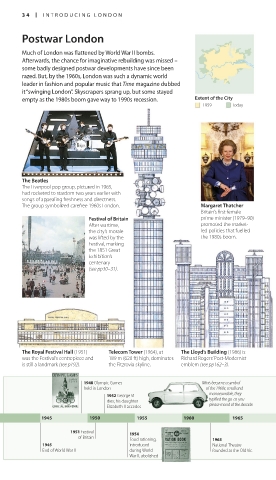
The Beatles
The Liverpool pop group, pictured in 1965,
had rocketed to stardom two years earlier with
songs of appealing freshness and directness.
The group symbolized carefree 1960s London. Margaret Thatcher
Britain’s first female
Festival of Britain prime minister (1979–90)
After wartime, promoted the market-
the city’s morale led policies that fuelled
was lifted by the the 1980s boom.
Festival, marking
the 1851 Great
Exhibition’s
centenary
(see pp30–31).
The Royal Festival Hall (1951) Telecom Tower (1964), at The Lloyd’s Building (1986) is
was the Festival’s centrepiece and 189 m (620 ft) high, dominates Richard Rogers’ Post-Modernist
is still a landmark (see p192). the Fitzrovia skyline. emblem (see pp162–3).
1948 Olympic Games Minis became a symbol
held in London of the 1960s; small and
manoeuvrable, they
1952 George VI
dies; his daughter typified the go-as-you-
Elizabeth II accedes please mood of the decade.
1945 1950 1955 1960 1965
1951 Festival 1954
of Britain
Food rationing, 1963
1945 introduced National Theatre
End of World War II during World founded at the Old Vic
War II, abolished
034-035_EW_London.indd 34 21/03/17 2:24 pm

