


Page 31 - (DK Eyewitness) Travel Guide - London
P. 31
THE HIST OR Y OF L ONDON 29
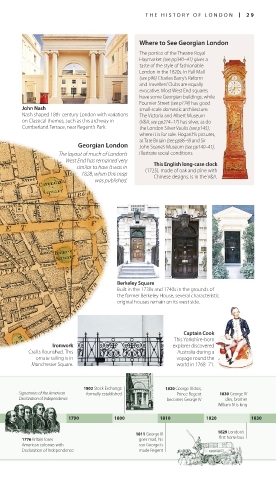
Where to See Georgian London
The portico of the Theatre Royal
Haymarket (see pp340–41) gives a
taste of the style of fashionable
London in the 1820s. In Pall Mall
(see p96) Charles Barry’s Reform
and Travellers’ Clubs are equally
evocative. Most West End squares
have some Georgian buildings, while
Fournier Street (see p174) has good
John Nash small-scale domestic architecture.
Nash shaped 18th-century London with variations The Victoria and Albert Museum
on Classical themes, such as this archway in (V&A, see pp214–17) has silver, as do
Cumberland Terrace, near Regent’s Park. the London Silver Vaults (see p145),
where it is for sale. Hogarth’s pictures,
at Tate Britain (see pp86–9) and Sir
Georgian London John Soane’s Museum (see pp140–41),
The layout of much of London’s illustrate social conditions.
West End has remained very
This English long-case clock
similar to how it was in (1725), made of oak and pine with
1828, when this map Chinese designs, is in the V&A.
was published.
Berkeley Square
Built in the 1730s and 1740s in the grounds of
the former Berkeley House, several characteristic
original houses remain on its west side.
Captain Cook
This Yorkshire-born
Ironwork explorer discovered
Crafts flourished. This Australia during a
ornate railing is in voyage round the
Manchester Square. world in 1768–71.
1768 Royal 1802 Stock Exchange 1820 George III dies,
Academy Signatories of the American formally established Prince Regent 1830 George IV
of Art Declaration of Independence becomes George IV dies, brother
established William IV is king
1770 1790 1800 1810 1820 1830
1829 London’s
1811 George III
1776 Britain loses goes mad, his first horse bus
American colonies with son George is
Declaration of Independence made Regent
028-029_EW_London.indd 29 21/03/17 2:19 pm

