


Page 32 - (DK Eyewitness) Travel Guide - London
P. 32
30 INTRODUCING L ONDON
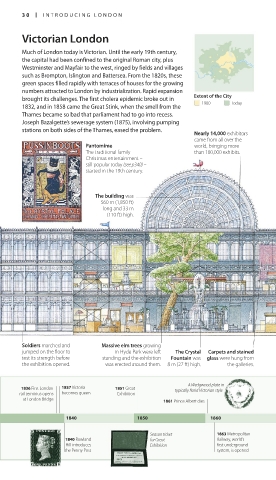
Victorian London
Much of London today is Victorian. Until the early 19th century,
the capital had been confined to the original Roman city, plus
Westminster and Mayfair to the west, ringed by fields and villages
such as Brompton, Islington and Battersea. From the 1820s, these
green spaces filled rapidly with terraces of houses for the growing
numbers attracted to London by industrialization. Rapid expansion
brought its challenges. The first cholera epidemic broke out in Extent of the City Today
1900
1832, and in 1858 came the Great Stink, when the smell from the
Thames became so bad that parliament had to go into recess.
Joseph Bazalgette’s sewerage system (1875), involving pumping
stations on both sides of the Thames, eased the problem.
Nearly 14,000 exhibitors
came from all over the
Pantomime world, bringing more
The traditional family than 100,000 exhibits.
Christmas entertainment –
still popular today (see p340) –
started in the 19th century.
The building was
560 m (1,850 ft)
long and 33 m
(110 ft) high.
Soldiers marched and Massive elm trees growing
jumped on the floor to in Hyde Park were left The Crystal Carpets and stained
test its strength before standing and the exhibition Fountain was glass were hung from
the exhibition opened. was erected around them. 8 m (27 ft) high. the galleries.
A Wedgwood plate in
1836 First London 1837 Victoria 1851 Great typically florid Victorian style
rail terminus opens becomes queen Exhibition
at London Bridge
1861 Prince Albert dies
1840 1850 1860 1870
Season ticket 1863 Metropolitan
1840 Rowland for Great Railway, world’s
Hill introduces Exhibition first underground
the Penny Post system, is opened
030-031_EW_London.indd 30 21/03/17 2:19 pm

